
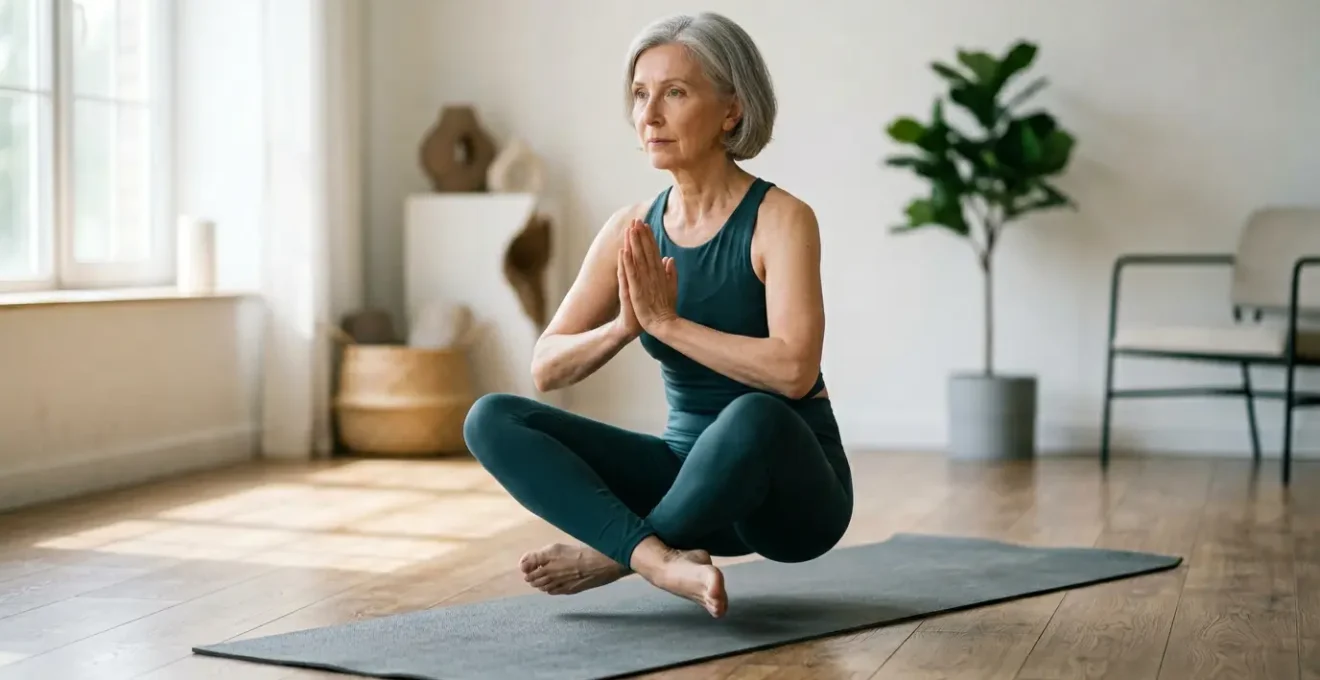
The simple act of getting up from the floor without using your hands is a powerful indicator of your long-term health and independence, but it’s a skill, not a destiny.
- Loss of this ability is less about age and more about a “chair-centric” lifestyle that disconnects us from natural, ground-level movements.
- Reclaiming this skill involves focusing on active mobility and consistent, small daily practices, not just passive stretching.
Recommendation: Start by incorporating a 3-minute morning hip mobility routine to “grease the groove” and begin your journey back to movement freedom.
Remember playing on the floor with your kids? Or maybe now, it’s the grandkids. You get down without a thought, but when it’s time to stand up, there’s a moment of hesitation. A plan forms in your head: “Okay, hand here, push off this knee… oof.” That subtle grunt is more than just a sound; it’s a quiet signal from your body. For many of us in middle age, this experience is the first hint that our relationship with gravity is changing. We often dismiss it as “just getting older” or decide we “need to stretch more,” but these explanations miss the bigger picture.
The issue isn’t a number on a birthday cake. It’s the environment we’ve built—a world of couches, office chairs, and car seats that has systematically untrained our bodies from performing one of the most fundamental human movements: getting up from the ground. This loss of ‘movement freedom’ has profound implications, extending far beyond a moment of awkwardness. It touches on our independence, our confidence, and, as startling research shows, even our longevity. But this isn’t a one-way street toward stiffness and dependency.
What if the key wasn’t just about stretching hamstrings but about reclaiming our body’s innate intelligence? This article reframes the challenge. We’ll explore why the ability to get off the floor is such a critical health marker and, more importantly, provide a practical roadmap to restore it. We will decode the difference between flexibility and true mobility, identify the hidden weaknesses that accelerate decline, and offer simple, daily practices to rebuild your strength and confidence from the ground up. This is your guide to not just aging well, but living with vibrant, playful independence for years to come.
This guide breaks down the science and the solutions into a clear, actionable path. We will explore everything from quick morning routines to the psychology of movement, giving you all the tools you need to reclaim your body’s natural capabilities.
Summary: A Practical Guide to Reclaiming Your Movement Freedom
- Why Can’t You Stand Up Without Hands anymore?
- How to Grease the Groove of Your Hips Before Your Morning Coffee?
- Yoga or Animal Flow: Which Better Prepares You for Real Life Movement?
- The One-Sided Weakness That Leads to Hip Replacements
- How to Deep Squat Daily to Maintain Pelvic and Hip Function?
- Flexibility or Mobility: Which Actually Helps You Avoid Injury?
- Why Is Your Handshake Strength a Predictor of All-Cause Mortality?
- Why the Fear of Falling Is Actually the Biggest Risk Factor for Falling?
Why Can’t You Stand Up Without Hands anymore?
The difficulty of getting off the floor without support is a modern problem, and it has a name: the Sitting-Rising Test (SRT). This simple assessment, which involves sitting down on and standing up from the floor, is surprisingly predictive. In fact, a groundbreaking Brazilian study found that individuals who required the most assistance had a 5-6 times higher risk of death from all causes compared to those who could do it without help. But why is this single movement so revealing? It’s not about the act itself, but what the inability to perform it represents: a loss of neuromuscular coordination, balance, and functional strength.
This decline isn’t an inevitable consequence of aging. It’s a direct result of our “chair-centric” epidemic. From the office to the car to the couch, modern life systematically removes the need for ground-level living, a fundamental aspect of human existence for millennia.
As the illustration above starkly contrasts, we’ve traded the dynamic engagement of floor postures for the passive support of chairs. This constant outsourcing of our body’s support system leads to “movement amnesia.” Your hips forget their full range of motion, your core weakens, and your brain’s map for coordinating a complex sequence like standing up becomes rusty. The test score isn’t a judgment; it’s a diagnostic tool. It reveals the degree to which our environment has robbed us of our innate movement competence.
How to Grease the Groove of Your Hips Before Your Morning Coffee?
The secret to reversing age-related stiffness isn’t grueling, hour-long workouts. It’s about consistency and frequency, a concept from strength training known as “greasing the groove.” This principle states that performing a movement frequently at low intensity is more effective for building a neurological pattern than infrequent, high-intensity efforts. Your goal is to gently remind your hips and brain how to work together every single day. A short, simple routine done before your first cup of coffee can be transformational.
Think of it as waking up your joints. After hours of stillness during sleep, your hips are “cold.” A few minutes of controlled movement increases synovial fluid circulation, nourishing the cartilage and improving your range of motion for the entire day. This isn’t about pushing into pain; it’s about exploring your current limits with gentle, controlled motions. This consistent practice can yield surprisingly rapid results, reconnecting you with a feeling of youthful fluidity. A 59-year-old participant in GMB’s Mobility program perfectly captured this, reporting: “I came to you 7 weeks ago with a hip problem. I’m now moving around like a 20-year-old!” This highlights that targeted, daily practice can dramatically reverse stiffness.
Here is a simple sequence you can integrate into your morning routine:
- Tabletop Hip Circles: Start on your hands and knees. Bring one knee toward your chest, then circle it out to the side, back, and around. Perform slowly for 30-60 seconds on each side, focusing on making the biggest, smoothest circle your hip can manage.
- Controlled Hip Flexor Marches: Lie on your back with knees bent. Slowly raise one knee toward your chest, using your core to keep your pelvis stable. Lower it with control and alternate sides. Perform 5 slow repetitions per side.
- Standing Hip Swings: Hold onto a chair or wall for balance. Gently swing one leg forward and backward 10 times, then side to side 10 times. Keep the movement fluid, not forced. Repeat on the other leg.
Yoga or Animal Flow: Which Better Prepares You for Real Life Movement?
Once you’ve started to “grease the groove,” you might consider a more structured practice. Yoga and Animal Flow are two popular choices, but they serve different functional purposes. Yoga, with its focus on static holds and controlled transitions, is excellent for developing flexibility, balance, and body awareness. It teaches you to be comfortable in end-range positions. However, traditional yoga practices often lack the dynamic, multi-planar movements that mimic the chaos of “real life”—like catching a falling object or playing with a toddler.
Animal Flow, by contrast, is built entirely on ground-based, flowing movements. It heavily emphasizes the transitions between positions, challenging your body to shift weight, rotate, and move through space in a fluid, quadrupedal manner. This constantly challenges your proprioception (your sense of where your body is in space) and directly trains the patterns needed for a seamless floor-to-stand transfer. As Peloton instructor Andy Speer notes, consistency is more important than duration. He advises, “Mobility gives your body room to move. It’s more beneficial to practice mobility five times a week, for 5 to 10 minutes each time, than it is to do an hour-long session once a week.” This philosophy applies to both practices.
The best choice depends on your goal. For building a foundation of flexibility and mindful control, yoga is fantastic. For developing the specific, dynamic strength and coordination to navigate the world with fluid power, Animal Flow has a clear edge. The following table breaks down their key differences:
| Aspect | Yoga | Animal Flow |
|---|---|---|
| Movement Pattern | Static holds, controlled transitions | Dynamic, flowing movements |
| Floor-to-Stand Transfer | Limited in traditional practice | Core component of practice |
| Proprioceptive Challenge | Moderate through balance poses | High through constant weight shifting |
| Real-World Application | Flexibility and balance focus | Multi-planar movement patterns |
| Learning Curve | Gradual progression | Steeper initial learning |
Ultimately, the best practice is the one you do consistently. Many find a combination of the two—using yoga for flexibility and Animal Flow for dynamic movement—offers the most comprehensive benefits for all-around movement freedom.
The One-Sided Weakness That Leads to Hip Replacements
As you begin to explore movement, you might notice something unsettling: one side of your body feels significantly stronger, more stable, or more flexible than the other. This isn’t just a curiosity; it’s a major red flag. These asymmetries are a leading contributor to chronic pain and, eventually, joint replacements. We all have a dominant side, but a significant imbalance in strength and mobility between your left and right hips forces your body into dysfunctional compensation patterns. Over years, this uneven loading wears down cartilage and creates strain, with the weaker side often breaking down first.
Imagine always getting up from a chair by pushing off more with your right leg, or always carrying your grandchild on your left hip. These seemingly minor habits compound over decades. The “stronger” side gets overworked, and the “weaker” side gets progressively weaker and less stable. This one-sided weakness is particularly dangerous because it undermines the foundation of your movement. It can lead to a cascade of issues, from lower back pain to knee problems, as the rest of your body tries to compensate for a hip that isn’t doing its job.
Identifying your own imbalances is the critical first step toward correcting them. You don’t need fancy equipment; a simple self-assessment can reveal a great deal about your body’s preferred patterns. By paying attention to these differences, you can start to address them with targeted exercises, consciously using your non-dominant side more often to restore balance and protect your joints for the long haul.
Your 60-Second Dominant Side Checklist
- Timed Rise/Sit Test: Time how long it takes to stand up from a chair and sit back down 5 times, using only your right leg for primary push-off (keep the left foot light).
- Compare the Other Side: Repeat the test, this time using your left leg as the primary driver. Note any significant difference in time, wobbling, or perceived effort.
- Single-Leg Balance: Stand on one leg and time how long you can hold your balance without hopping or touching down. Compare the duration for each side.
- Figure-Four Flexibility: While sitting, cross your right ankle over your left knee. Gently press on the right knee and note the sensation of tightness in your hip. Repeat on the other side and compare.
- Action Plan: Note which side is weaker or tighter. Make a conscious effort to lead with this non-dominant side for daily activities like climbing stairs or getting out of a car.
How to Deep Squat Daily to Maintain Pelvic and Hip Function?
For most of human history, the deep squat was a natural resting position. It’s how we cooked, socialized, and rested. Today, for many in the Western world, it’s an impossible posture. Reclaiming the deep squat is one of the most powerful things you can do for your hip and pelvic health. It’s a full-body movement that promotes ankle, knee, and hip mobility simultaneously, lengthens the spine, and allows the pelvic floor muscles to fully relax and stretch—a crucial function for both men and women.
As professional trainer Dave Connor from adidas emphasizes, “Hip mobility is important because your hips are your engine. They’re what allow you to do virtually every athletic movement.” The deep squat is the fundamental maintenance routine for that engine. Daily practice, even for just a few minutes, can dramatically improve your range of motion and functional strength. The goal isn’t to become a powerlifter; it’s to restore a natural human posture.
Most people can’t just drop into a perfect deep squat. The key is a gradual, assisted progression. Start by holding onto a sturdy door frame or countertop for support. This allows you to control the depth and take the load off your joints while your body adapts. Over several weeks, you can gradually reduce the support, perhaps placing small books under your heels to compensate for limited ankle mobility, until you can hold the position unassisted. The daily goal should be to accumulate 3-5 minutes in the position, breaking it up into 30-60 second holds throughout the day. This is ground-level living in action.
Flexibility or Mobility: Which Actually Helps You Avoid Injury?
The terms “flexibility” and “mobility” are often used interchangeably, but they describe two very different qualities. Understanding the distinction is crucial for effective injury prevention. Flexibility is a passive quality; it’s the ability of a muscle to lengthen. Think of someone who can easily touch their toes or do the splits. This is passive range of motion. Mobility, on the other hand, is an active quality. It is your ability to actively control your joints through their full range of motion. It requires strength, stability, and coordination.
As one expert from Yale Medicine clarifies, “One way to think about it is that mobility is specific to joints, and flexibility is specific to joints and muscles. Someone can have great hip mobility, for example, but not have the muscle flexibility to do a split.” You can be very flexible but have poor mobility. For example, you might be able to pull your leg into a deep stretch (flexibility), but lack the strength to lift it there without assistance (mobility). This gap between passive and active range of motion is where many injuries occur. Your body can be forced into a position that it cannot actively control or exit safely.
For real-world resilience—like stabilizing yourself after a trip or lifting a heavy grandchild—mobility is far more important than flexibility. The goal of your training should be to build active control over your range of motion. This means shifting focus from passive, static stretching to active mobility drills that challenge your joints to move under their own power. This approach builds strength and stability throughout the entire range of motion, creating a more resilient and “injury-proof” body.
Here are some examples of how to shift from passive stretching to active mobility drills:
- Instead of a passive hamstring stretch, perform active straight leg raises while lying on your back.
- Swap a static hip flexor lunge for controlled hip circles on all fours.
- Trade the static butterfly stretch for active 90/90 hip rotations, using your muscles to move your legs.
- Replace a passive calf stretch against a wall with dynamic ankle circles and pointing/flexing movements.
Key Takeaways
- Your ability to get off the floor (the SRT) is a powerful proxy for your overall functional health and longevity.
- Mobility is an active skill requiring strength and control, not just passive flexibility from stretching.
- Small, consistent daily practices (“greasing the groove”) are far more effective for long-term improvement than infrequent, intense workouts.
Why Is Your Handshake Strength a Predictor of All-Cause Mortality?
While hip function is a cornerstone of movement freedom, another, simpler measurement provides a stunningly accurate snapshot of your overall health: your grip strength. For decades, researchers have noted a powerful correlation between a firm handshake and a longer, healthier life. This isn’t about having a crushing grip to intimidate business partners; it’s about what grip strength represents as a biological marker. It serves as an easy-to-measure proxy for your overall muscle mass and systemic health. Weak grip strength is often the first sign of sarcopenia (age-related muscle loss), a condition linked to a host of negative health outcomes.
The data is compelling. A Japanese study found a 21% reduction in mortality risk per 5kg increase in grip strength. Even more revealing is the massive PURE study, which followed 140,000 people across 17 countries. It found that grip strength was a more powerful predictor of cardiovascular mortality than systolic blood pressure. Why? Because the systems that build and maintain muscle in your hands are the same systems that support your entire body. A strong grip indicates a well-functioning nervous system, adequate protein synthesis, and good hormonal health—all pillars of vitality.
Unlike blood pressure, which can fluctuate wildly, grip strength is a stable and reliable indicator of your “biological age.” It reflects your body’s overall resilience and capacity. The good news is that, like mobility, grip strength is highly trainable. Activities that challenge your grip—from carrying groceries and doing farmer’s walks to simple hangs from a pull-up bar—can directly improve this vital health marker. It’s a reminder that full-body strength, right down to your fingertips, is integral to a long and functional life.
Why the Fear of Falling Is Actually the Biggest Risk Factor for Falling?
The physical decline in mobility and strength is only half the story. The other, arguably more powerful, factor is psychological: the fear of falling. For those over 65, falls are currently the leading cause of injury-related death. This statistic is terrifying, and it creates a vicious cycle. Fear of falling leads to activity avoidance. You stop going for walks on uneven ground, you avoid playing on the floor, you move more slowly and stiffly. This reduction in activity directly leads to a real-world loss of strength, balance, and coordination—the very skills needed to prevent a fall. Your world shrinks as your confidence evaporates.
This is the “confidence-competence loop” in reverse. As your movement competence decreases, your confidence plummets. This lack of confidence leads you to avoid challenging movements, which further erodes your competence. You become trapped in a downward spiral where the fear itself creates the physical conditions that make a fall more likely. The fear becomes a self-fulfilling prophecy. This is why addressing the psychological component is just as important as the physical exercises.
So how do you break the cycle? You don’t overcome the fear by avoiding the risk; you overcome it by building competence in a safe, controlled environment. This brings us full circle to the Sitting-Rising Test. As Harvard’s Mary Kate Miller, a clinical supervisor at Spaulding Rehabilitation, explains, “If you fear ending up on the ground without being able to get up, the best thing you can do is find a physical therapist to help you.” Practicing floor-to-stand movements systematically dismantles the fear. Each successful repetition, even with assistance, rebuilds the confidence-competence loop in a positive direction. You are proving to your brain and body that you are capable, resilient, and in control.
The journey to reclaiming your movement freedom isn’t about achieving a perfect score or performing superhuman feats. It’s about taking the first step. It’s about choosing to engage with your body, to “grease the groove” daily, and to bravely practice the very movements you fear. Start today by choosing one small action from this guide and making it a non-negotiable part of your routine.