
Many believe diet is the only weapon against insulin resistance, but this overlooks the body’s most powerful metabolic regulator: skeletal muscle.
- Muscle acts as a “glucose sponge,” absorbing up to 80% of sugar from your blood after a meal.
- Having low muscle mass, even with a normal BMI (“TOFI”), significantly increases your risk of metabolic syndrome and heart disease.
Recommendation: Prioritizing resistance training isn’t just for aesthetics; it’s a primary medical strategy for restoring insulin sensitivity.
As a metabolic endocrinologist, I frequently encounter patients, particularly those with pre-diabetes or type 2 diabetes, who are frustrated. They meticulously track their carbohydrate intake, choose low-glycemic foods, and yet their blood sugar control remains elusive. Their focus is almost entirely on diet, a critical component, but they are often overlooking the most powerful tool at their disposal for glucose management. They see the gym as a place for bodybuilders, not as a clinical necessity for their condition. This perspective misses a fundamental truth of human physiology.
The conversation about insulin resistance is too often limited to what we put into our bodies. We discuss sugar, processed foods, and meal timing. But what if the primary issue isn’t just the glucose load, but the body’s capacity to dispose of that glucose? The key to this puzzle isn’t found on your plate, but in your largest metabolic organ system: your skeletal muscle. It functions as a massive, dynamic reservoir for blood sugar, a “metabolic sink” that can be trained to be more efficient.
This article will reframe your understanding. We will move beyond the aesthetic view of muscle and explore its profound role as a regulator of metabolic health. We will dissect the mechanisms by which muscle clears sugar from your blood, explain why your body composition is a far better health indicator than your weight, and provide actionable strategies to leverage this powerful biological system. The goal is to shift your perspective from passively restricting your diet to actively building your body’s primary defense against insulin resistance.
In the following sections, we will explore the science behind muscle’s role as a metabolic powerhouse. This guide breaks down exactly how this system works and how you can optimize it for your long-term health.
Summary: The Critical Role of Muscle in Metabolic Health
- How Does Leg Muscle Soak Up Sugar From Your Bloodstream After a Meal?
- Why Staying the Same Weight but Losing Inches Is the Ultimate Goal?
- How Many Extra Calories Does 1kg of Muscle Actually Burn at Rest?
- The Low-Muscle Danger That Doubles Your Risk of Heart Disease
- How to Maintain Your Muscle Mass with Only 2 Workouts a Week?
- Why High Fasting Insulin Is a Red Flag Your GP Might Not Mention?
- Why You Lose 3-5% of Muscle Mass per Decade After 30 Without Intervention?
- Why Is Your Metabolic Health Poor Even If Your BMI Is Normal?
How Does Leg Muscle Soak Up Sugar From Your Bloodstream After a Meal?
After you consume a carbohydrate-rich meal, your blood glucose levels rise, signaling the pancreas to release insulin. This is where your skeletal muscle, particularly large groups like those in your legs and glutes, plays its leading role. Muscle tissue is the primary site for glucose disposal in the body. In fact, comprehensive research demonstrates that skeletal muscle accounts for up to 80% of whole-body glucose uptake under insulin-stimulated conditions. It acts like a massive “glucose sponge,” ready to soak up sugar and prevent it from lingering in the bloodstream where it can cause damage.
This process occurs through two main pathways. The first is insulin-dependent. Insulin binds to receptors on muscle cells, which triggers a signaling cascade that mobilizes glucose transporters, primarily GLUT4, to the cell surface. These transporters act like gates, opening up to allow glucose to enter the muscle cell from the bloodstream. Once inside, the glucose is either used immediately for energy or, more importantly, stored as glycogen for future use. A person with healthy, insulin-sensitive muscles has a vast storage capacity for glycogen, preventing blood sugar from spiking excessively.
The second pathway is non-insulin-dependent and is activated by muscle contraction itself—that is, through exercise. Physical activity, especially resistance training, stimulates a molecule called AMPK. This master metabolic switch can also trigger GLUT4 to move to the cell surface, independent of insulin levels. This is why a brisk walk or a set of squats after a meal can be so effective at lowering blood sugar; you are manually opening the gates to your muscle cells. The more muscle mass you have, and the more efficient it is, the larger your glucose sponge and the better your metabolic control.
Why Staying the Same Weight but Losing Inches Is the Ultimate Goal?
For individuals grappling with metabolic dysfunction, the bathroom scale can be a misleading and often discouraging metric. A focus solely on weight loss ignores a far more critical process for long-term health: body recomposition. This is the process of simultaneously reducing fat mass while maintaining or increasing muscle mass. It is entirely possible for your weight to remain stable while your health transforms, as you trade metabolically harmful fat for metabolically beneficial muscle. This is why losing inches around your waist, while your weight stays the same or even slightly increases, is a sign of profound metabolic improvement.
Muscle is dense and compact, while fat is voluminous and “fluffy.” One kilogram of muscle takes up significantly less space than one kilogram of fat. Therefore, as you build muscle and lose fat, your clothes will fit better and your physique will become leaner, even if the number on the scale doesn’t budge. More importantly, this shift dramatically alters your metabolic risk profile. Having low muscle mass, even if you are not overweight, is a significant danger. This condition, often called “sarcopenic obesity” or being “skinny-fat,” is a potent driver of metabolic disease.
The clinical evidence on this is unequivocal. A study on body composition phenotypes revealed the hidden risks associated with poor muscle mass. As researchers noted, a state of low muscle combined with high fat is a dangerous combination for your metabolic health.
Low muscle/high fat (IRR: 1.90; 95% confidence interval [CI]:1.44–2.50) and high muscle/high fat (IRR: 2.30; 95% CI:1.76–3.00) were significantly associated with the prevalence of metabolic syndrome
– Kim et al., Scientific Reports, Nature
This highlights that simply being “low fat” is not enough; having adequate muscle is protective. Chasing a lower number on the scale at the expense of muscle is a metabolically damaging strategy. The true goal is to build an engine, not just to lighten the chassis.
How Many Extra Calories Does 1kg of Muscle Actually Burn at Rest?
A common belief in fitness circles is that gaining muscle will dramatically skyrocket your resting metabolism, turning your body into a 24/7 fat-burning furnace. While muscle is indeed more metabolically active than fat, the numbers are often exaggerated. Understanding the real figure is crucial for setting realistic expectations and appreciating the true, more profound metabolic benefits of muscle mass. So, how many calories does it actually burn?
The scientific consensus is that the resting metabolic rate of muscle is relatively modest. Rigorous analysis shows that each kilogram of muscle burns approximately 13 kcal/kg/day at rest. In contrast, a kilogram of fat burns only about 4.5 kcal/kg/day. So, while muscle is roughly three times more active, gaining 5 kg of muscle would only increase your daily resting energy expenditure by about 65 calories—the equivalent of a small apple. If your goal is purely passive calorie burning, this might seem underwhelming.
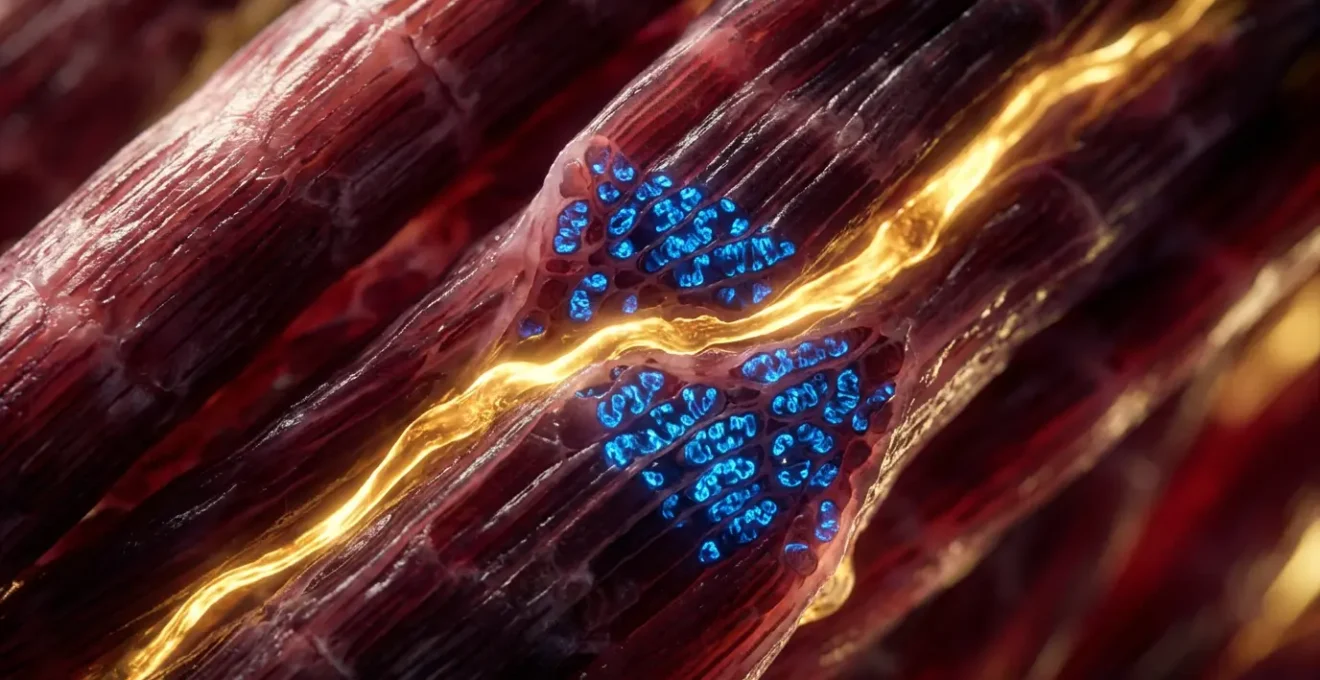
However, this view completely misses the point. The primary metabolic value of muscle isn’t its passive calorie burn, but its role as an active glucose-management system. The real benefit comes from what muscle *does*, not just what it *is*. It’s the organ that actively consumes glucose, improves insulin signaling, and creates a buffer against metabolic disease. It is a metabolically dynamic tissue, rich in mitochondria, the power plants of our cells, that are constantly working to maintain energy balance.
As this visualization of muscle tissue suggests, its value lies in its active, energetic function. Focusing on the small number of calories it burns at rest is like valuing a high-performance engine for the heat it gives off while idling. The true power is unleashed when you put it to use. The more muscle you have, the greater your capacity to handle carbohydrates and the more resilient your metabolism becomes.
The Low-Muscle Danger That Doubles Your Risk of Heart Disease
The connection between insulin resistance and cardiovascular disease is well-established, but the central role of skeletal muscle in this dangerous pathway is often underappreciated. When you have insufficient or insulin-resistant muscle mass, your body’s ability to manage glucose is severely compromised. This doesn’t just lead to high blood sugar; it initiates a cascade of metabolic events that directly contribute to heart disease, effectively doubling your risk.
Here’s the mechanism: when your primary glucose sink—your muscle—is “full” or unresponsive to insulin, the glucose from your meals has nowhere to go. It gets diverted to the liver. In response, the liver converts this excess sugar into fat through a process called de novo lipogenesis. This leads to a state known as atherogenic dyslipidemia, characterized by high triglycerides, low levels of “good” HDL cholesterol, and an increase in small, dense, and particularly dangerous LDL particles. These are the very factors that promote the formation of plaque in your arteries (atherosclerosis), leading to heart attacks and strokes.
Therefore, low muscle mass is not a passive risk factor; it is an active driver of cardiovascular disease. Conversely, building and maintaining muscle is one of the most potent protective strategies available. Increasing muscle mass directly improves your body’s ability to handle glucose, which takes the metabolic pressure off the liver. This can lead to dramatic improvements in your lipid profile. In fact, large-scale studies show an 11% reduction in insulin resistance for every 10% increase in skeletal muscle mass index. This is a direct, dose-dependent relationship demonstrating that more muscle equals better insulin sensitivity and, consequently, a healthier heart.
How to Maintain Your Muscle Mass with Only 2 Workouts a Week?
For individuals managing diabetes or pre-diabetes, the idea of adding a rigorous workout regimen can feel overwhelming. The good news is that maintaining, and even building, metabolically crucial muscle mass does not require spending hours in the gym every day. The principle of minimum effective dose applies here. With a smart, targeted approach, just two full-body resistance training sessions per week can be remarkably effective at halting age-related muscle loss (sarcopenia) and improving insulin sensitivity.
The key is not volume, but intensity and consistency. The goal of these workouts is to provide a strong enough stimulus to signal your muscles that they are needed and must adapt by becoming stronger and more efficient at storing glucose. A session doesn’t need to be long, but it needs to be challenging. This means lifting a weight that is heavy enough so that the last couple of repetitions in a set are difficult to complete with good form. This intensity is what recruits the maximum number of muscle fibers, sending the powerful signal for growth and repair.
Combining this training stimulus with adequate protein intake creates a powerful synergistic effect. Protein provides the building blocks for muscle repair and synthesis. Spacing your protein intake throughout the day—a strategy known as “protein pacing”—helps to keep muscle protein synthesis elevated. Following a structured plan is the most effective way to ensure you are hitting all the key elements for success.
Your action plan: minimum effective dose for muscle maintenance
- Focus on compound movements: Prioritize exercises like squats, deadlifts, overhead presses, and rows. These movements engage the most muscle mass simultaneously, providing the biggest metabolic “bang for your buck.”
- Prioritize intensity over volume: Choose a weight that challenges you to complete 8-12 repetitions. The focus should be on the quality and effort of each set, not the total number of sets.
- Implement protein pacing: Aim to consume 25-30g of high-quality protein in 3-4 meals spread throughout the day to consistently stimulate muscle protein synthesis.
- Commit to two weekly sessions: Two well-executed, full-body resistance workouts per week are sufficient to provide the stimulus needed to halt sarcopenia and improve metabolic health.
- Ensure adequate total protein: Combine your training with an optimal total daily protein intake, aiming for at least 1.2 grams per kilogram of your body weight for synergistic effects.
Why High Fasting Insulin Is a Red Flag Your GP Might Not Mention?
In a standard check-up, your doctor will almost certainly test your fasting blood glucose. If it’s within the normal range, you’ll likely be told everything is fine. However, this single metric can be dangerously misleading, masking a metabolic problem that may have been developing for years, or even decades. The test your doctor might not run, but which provides a much earlier and more sensitive warning, is fasting insulin. High fasting insulin, a condition known as hyperinsulinemia, is the real red flag.
Insulin resistance doesn’t happen overnight. In the early stages, your muscle, liver, and fat cells start becoming less responsive to insulin’s signal. To compensate and keep your blood glucose in a normal range, your pancreas works overtime, pumping out more and more insulin. For a long time, this compensation works. Your fasting glucose looks perfect, but underneath the surface, your insulin levels are steadily climbing. You are “swimming” in a sea of insulin just to maintain metabolic normalcy.
This is the critical window for intervention. By the time your fasting glucose starts to rise, your pancreas is already beginning to tire out, and the progression to pre-diabetes or type 2 diabetes is well underway. Measuring fasting insulin can detect this compensatory phase long before blood sugar becomes abnormal. In their seminal work, leading endocrinologists Ralph DeFronzo and Devjit Tripathy stated this clearly:
Skeletal muscle insulin resistance is considered to be the initiating or primary defect that is evident decades before β-cell failure and overt hyperglycemia develops
– DeFronzo & Tripathy, Diabetes Care, American Diabetes Association
If your fasting insulin is elevated, it’s a direct sign that your body is struggling. It’s a call to action to improve the insulin sensitivity of your skeletal muscle—the primary defect—before your pancreas can no longer keep up. It’s a signal to start building your muscular defense system immediately.
Why You Lose 3-5% of Muscle Mass per Decade After 30 Without Intervention?
Beginning around the age of 30, our bodies enter a state of “anabolic resistance,” marking the start of a slow, insidious process of muscle loss known as sarcopenia. Without deliberate intervention, the average adult will lose approximately 3-5% of their muscle mass per decade. While this may sound like a slow process, its cumulative effect is devastating for metabolic health and overall longevity. This isn’t just a cosmetic issue of becoming less “toned”; it’s the gradual dismantling of your body’s most important metabolic engine.
This age-related decline is driven by a combination of factors. Hormonal changes, such as a decrease in testosterone and growth hormone, play a role. More importantly, the cellular machinery within our muscles becomes less responsive to the signals for growth. The same amount of protein or the same exercise stimulus that would have easily triggered muscle protein synthesis in a 20-year-old has a blunted effect in a 40- or 50-year-old. This means that to maintain muscle mass as we age, we can’t just keep doing what we’ve always done; we need a more targeted and potent stimulus.
The visual difference at a microscopic level is stark. Young, healthy muscle fibers are dense, thick, and tightly packed. Sarcopenic muscle, on the other hand, is characterized by thinner, weaker fibers and an infiltration of fat and fibrous tissue. This not only reduces strength but also severely diminishes the muscle’s capacity to act as a glucose reservoir.
The crucial takeaway is that sarcopenia is not an inevitable fate; it is a process that can be significantly slowed, and in many cases, reversed. The two most powerful tools we have to combat it are resistance training and adequate protein intake. Resistance training provides the necessary stimulus to overcome anabolic resistance, while protein provides the raw materials for repair and growth. Failing to actively combat this decline means passively accepting a future of diminished strength, metabolic fragility, and increased risk of chronic disease.
Key Takeaways
- Muscle is a primary metabolic organ, not just a tissue for strength and aesthetics.
- Your body composition (muscle-to-fat ratio) is a far more accurate predictor of metabolic health than your BMI.
- Just two targeted resistance workouts per week, combined with adequate protein, can effectively preserve muscle mass and combat insulin resistance.
Why Is Your Metabolic Health Poor Even If Your BMI Is Normal?
One of the most dangerous misconceptions in modern health is the reliance on the Body Mass Index (BMI) as a definitive measure of well-being. It is entirely possible to have a “normal” BMI while being in a state of profound metabolic distress. This phenomenon is known as normal weight obesity, or more colloquially as TOFI (Thin Outside, Fat Inside). Individuals with this phenotype appear healthy on the outside but carry a significant amount of visceral fat—the dangerous fat that surrounds internal organs—and have critically low levels of muscle mass.
A normal BMI can mask a hazardous body composition. Someone who is inactive and has a poor diet may lose muscle mass over time while gaining visceral fat. Because muscle is denser than fat, their weight and BMI might not change significantly, lulling them into a false sense of security. However, this internal shift from metabolically active muscle to metabolically disruptive visceral fat wreaks havoc on insulin sensitivity and dramatically increases the risk for type 2 diabetes, heart disease, and non-alcoholic fatty liver disease.
The data unequivocally shows that muscle mass is a far better predictor of metabolic health than weight or BMI. Individuals with higher muscle mass exhibit significantly better insulin sensitivity, regardless of their weight. This protective effect is substantial. A comprehensive analysis of body composition and metabolic syndrome reveals just how misleading weight can be. The following table breaks down the risk associated with different body composition profiles.
| Body Composition Type | Insulin Resistance Risk | Metabolic Syndrome Prevalence |
|---|---|---|
| Low Muscle/Low Fat | Reference (1.0) | Baseline |
| Low Muscle/High Fat | IRR: 1.90 (95% CI: 1.44-2.50) | Significantly elevated |
| High Muscle/Low Fat | Significantly lower (p<0.001) | Reduced risk |
| High Muscle/High Fat | IRR: 2.30 (95% CI: 1.76-3.00) | Highest risk |
This data clearly shows that “Low Muscle/High Fat”—the classic TOFI profile—carries nearly double the risk of metabolic syndrome compared to the reference group. Most strikingly, the “High Muscle/Low Fat” group enjoys a significantly lower risk, proving that muscle is a powerful protective factor. This is why you cannot judge your metabolic health by the scale. The real question is not “How much do I weigh?” but “How much of my body is functional, metabolically active muscle?”
The next logical step is to shift your focus from solely diet to incorporating resistance training. Consult with a healthcare professional or a qualified trainer to design a program that safely and effectively builds your body’s best defense against insulin resistance.