
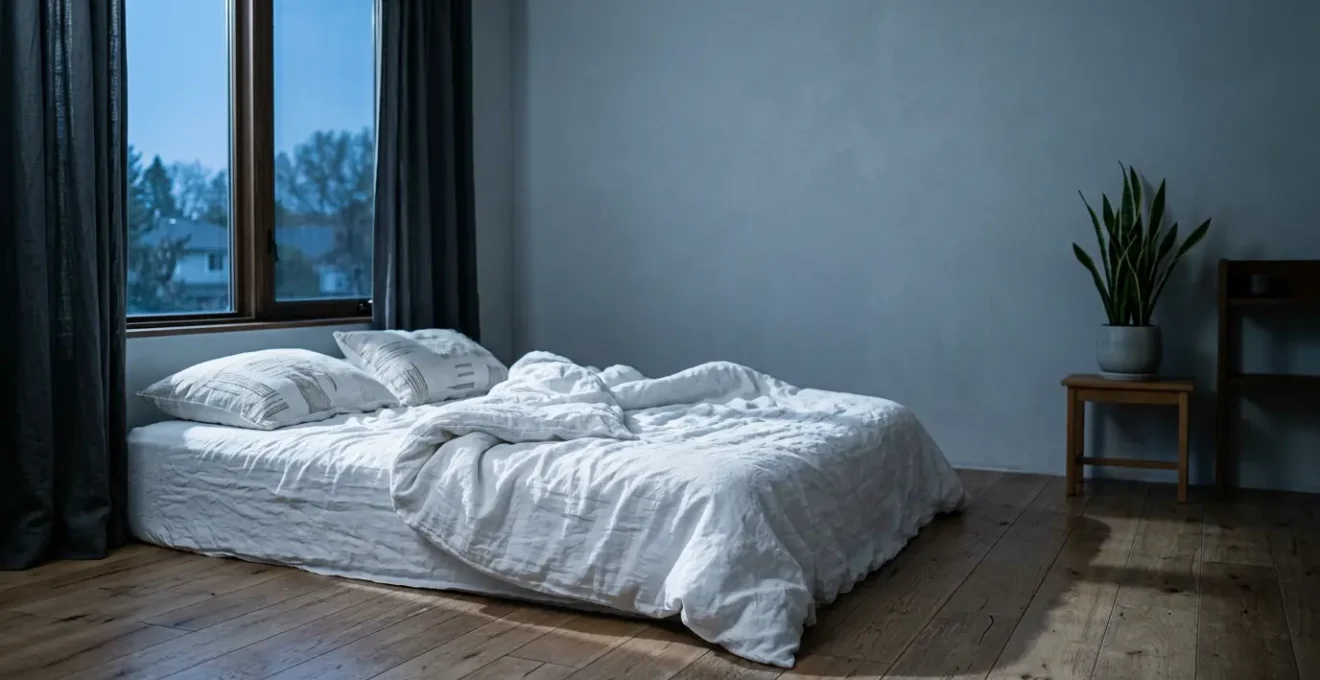
Your bedroom’s failure isn’t a lack of comfort; it’s a failure to send the correct biological signals to your brain.
- Temperature isn’t about preference; it’s a non-negotiable trigger for deep sleep via core body thermoregulation.
- Your bed has likely been conditioned into a ‘wakeful place’ through poor associations, a problem no gadget can fix.
Recommendation: Stop tweaking individual elements and start engineering your bedroom as a complete sensory control system designed for profound rest.
For the urban light sleeper, the night is a battlefield. You’ve followed the generic advice: you’ve bought thicker curtains, tried earplugs, and dutifully put your phone away an hour before bed. Yet, you still find yourself staring at the ceiling, acutely aware of the sliver of light from a streetlight or the distant hum of the city. The frustration is palpable because you’re doing everything “right,” but deep, restorative sleep remains elusive. The common wisdom tells you to make your room dark, quiet, and cool, but it rarely explains the precise mechanics of *why* this matters, or how to orchestrate these elements into a coherent system.
The problem is that we treat these factors as a checklist rather than as interconnected inputs into our brain’s most ancient operating system. The quality of your sleep isn’t determined by how comfortable your mattress feels, but by how effectively your environment signals to your biology that it is time for shutdown. But what if the true key wasn’t just blocking out the world, but meticulously crafting a set of specific environmental cues? What if the solution lies not in adding more, but in designing with more precision, like an architect building a sanctuary for the mind?
This is where we move beyond simple “sleep hygiene” and into the realm of sleep environment engineering. This guide deconstructs the four critical pillars of your bedroom’s sensory system: temperature, light, sound, and association. We will explore the specific mechanisms behind each, providing the data-driven blueprints you need to transform your bedroom from a source of sleep sabotage into a finely-tuned machine for recovery.
This article provides a detailed blueprint for re-engineering your sleep sanctuary. Below is a summary of the key systems we will deconstruct and optimize.
Summary: The Architect’s Guide to a High-Performance Sleep Environment
- 18 Degrees Celsius: Why Is a Cold Room Essential for Deep Sleep?
- Blackout Curtains or Eye Mask: Which Is More Effective for Melatonin?
- Pink Noise vs White Noise: Which Masking Sound Boosts Brain Waves?
- The Association Mistake That Trains Your Brain to Be Alert in Bed
- Memory Foam or Pocket Sprung: Which Is Best for a Hot Sleeper?
- Blue Light Blockers: Do These Glasses Actually Work or Is It Hype?
- How to Manage Humidity Levels in Your Home to Kill Airborne Viruses?
- Why Living Out of Sync with the Sun Is Making You Fat and Sad?
18 Degrees Celsius: Why Is a Cold Room Essential for Deep Sleep?
The single most overlooked environmental factor for sleep is ambient temperature. Many people aim for a “comfortable” or “cozy” room, but this is a fundamental misunderstanding of our biology. To initiate sleep, your body must lower its core temperature by approximately 1-2 degrees Celsius. This thermoregulation drop is a critical biological trigger that signals to your brain it’s time to enter the deeper, more restorative stages of sleep. A warm room actively fights against this process, forcing your body to work harder to cool down and delaying sleep onset.
The ideal temperature is not a matter of preference but of physiological function. The widely accepted optimal range is between 15.5 and 19.5 degrees Celsius (60-67°F), with 18°C (65°F) being a perfect target for most adults. Sleeping in a cooler environment facilitates this core temperature drop, allowing you to fall asleep faster and spend more time in slow-wave sleep and REM sleep. For urban dwellers in apartments with centrally controlled heating, achieving this can be a challenge, but strategies like using fans for air circulation or investing in cooling bedding materials become essential architectural choices.
Think of your bedroom’s thermostat not as a comfort setting, but as a primary control lever for your sleep-wake cycle. Setting it to a cooler temperature is one of the most powerful and direct environmental cues you can send to your body to prepare for profound rest. It’s a non-negotiable parameter in the design of a high-performance sleep environment.
Blackout Curtains or Eye Mask: Which Is More Effective for Melatonin?
Light is the most potent regulator of our circadian rhythm. Even minute amounts of light, particularly from street lamps or electronic devices, can penetrate the eyelid and signal to the suprachiasmatic nucleus in your brain that it’s daytime, suppressing the production of the sleep hormone, melatonin. The engineering challenge is achieving total darkness. The two primary tools for this are room-level intervention (blackout curtains) and personal-level intervention (eye masks). The choice is not merely about convenience; it carries significant consequences for your sleep-wake cycle.
Blackout curtains excel at creating an immersive, dark space, blocking up to 99% of external light. This is ideal for shift workers or those in brightly lit urban environments. However, their primary drawback is that they also block the gentle morning sunlight that is crucial for resetting your circadian rhythm and promoting wakefulness. An eye mask, conversely, provides 100% darkness directly over the eyes but allows ambient morning light to fill the room, facilitating a more natural wake-up process. This preserves the essential light cues your body needs to anchor its internal clock.
The following comparison table breaks down the key architectural differences between these two light-blocking strategies. As an analysis from the Sleep Foundation’s guide to bedroom design highlights, the trade-offs involve light control, circadian impact, and even thermal insulation.
| Feature | Blackout Curtains | Eye Mask |
|---|---|---|
| Light Blocking | 99% room darkness | 100% eye coverage |
| Morning Light Access | Blocks sunrise | Allows natural wake-up |
| Circadian Impact | May delay morning reset | Preserves light cues |
| Temperature Effect | Provides insulation | No thermal impact |
| Portability | Fixed installation | Travel-friendly |
For most urban sleepers, a high-quality, breathable silk or cotton eye mask offers a more precise and biologically sound solution. It decouples nighttime darkness from morning light, giving you the best of both worlds: complete melatonin protection during the night and a natural, light-induced awakening in the morning.
Pink Noise vs White Noise: Which Masking Sound Boosts Brain Waves?
For a light sleeper in a noisy city, silence is a fantasy. The goal is not to eliminate sound, but to control it. The solution is sound masking—using a constant, unobtrusive sound to cover up sudden, disruptive noises like traffic, sirens, or neighbors. The most common tools for this are white noise and pink noise machines, but they are not interchangeable. They have distinct frequency profiles that interact with your brain differently.
This is a visualization of how controlled sound can transform a chaotic auditory environment into a serene one.
White noise contains all audible frequencies at equal intensity, creating a ‘hissing’ sound similar to static. It’s an effective masker but can be perceived as harsh by some. Pink noise is a more balanced alternative. Its power decreases as the frequency increases, resulting in a deeper, more natural sound akin to steady rainfall or a gentle waterfall. Research suggests pink noise may be more effective at enhancing stable, deep sleep by boosting slow-wave brain activity. It masks disruptive high-frequency sounds while providing a soothing low-frequency base.
The choice is an engineering one: white noise is a brute-force solution for masking, while pink noise is a more nuanced tool for both masking and promoting sleep stability. For the urban dweller, pink noise often represents a superior choice, as it’s better at concealing the variable pitches of city life without introducing a harsh sound into the environment.
The Association Mistake That Trains Your Brain to Be Alert in Bed
One of the most profound acts of sleep sabotage is psychological, not physical. It’s the “association mistake”: teaching your brain that your bed is a place for activities other than sleep and intimacy. When you work, scroll through your phone, watch TV, or worry in bed, you are performing a classical conditioning experiment on yourself. Your brain, an incredibly efficient association machine, begins to link the physical context of your bed with a state of mental arousal and alertness. Over time, the bed itself becomes a trigger for wakefulness, not rest.
This is why the common experience of feeling tired on the sofa but instantly wide-awake upon getting into bed is so prevalent. You have inadvertently trained your brain to be on high alert in its designated sleeping area. The world’s leading sleep scientist, Dr. Matthew Walker, explains this phenomenon with uncompromising clarity.
Your brain will associate bed with being awake if you do anything in it besides sleeping or sex.
– Dr. Matthew Walker, MasterClass Sleep Science Course
To break this negative conditioning, you must be ruthlessly disciplined. The bed is for sleep and sex only. If you find yourself unable to fall asleep, don’t lie there tossing and turning, as this only reinforces the negative association. Experts recommend a strict rule: if you are not asleep after about 25 to 30 minutes, you must get out of bed. Go to another dimly lit room and do something relaxing—read a book, meditate—until you feel sleepy again, then return to bed. This re-establishes the bed as a place solely for sleep, retraining your brain to create a powerful brain-state association between your mattress and unconsciousness.
Memory Foam or Pocket Sprung: Which Is Best for a Hot Sleeper?
The mattress is the foundation of your sleep environment, but its most critical function beyond support is thermoregulation. For “hot sleepers”—individuals who tend to overheat at night—the material of the mattress is a crucial architectural decision. The primary conflict is between the contouring comfort of memory foam and the superior airflow of traditional pocket sprung or hybrid designs. Understanding the material science is key to making the right choice.
This is a close-up of modern mattress materials, designed for breathability and heat dissipation.
Traditional memory foam is a viscoelastic material that reacts to body heat and pressure, molding to your shape to provide excellent pressure relief. However, its dense, closed-cell structure is notorious for trapping heat. While modern foams incorporate cooling gels or open-cell designs, they often struggle to compete with the inherent breathability of other materials. This heat retention can prevent your core body temperature from dropping effectively, disrupting sleep.
Conversely, pocket sprung mattresses feature individual steel coils wrapped in fabric. This structure creates significant internal air pockets, allowing for continuous airflow that wicks away heat and moisture. Hybrid mattresses attempt to offer the best of both worlds by combining a pocket sprung support core with top layers of latex or advanced cooling foams. As a wealth of data from sleep science organizations confirms, spring and hybrid systems generally provide better temperature regulation than all-foam models. For a hot sleeper, a pocket sprung or hybrid mattress is almost always the superior engineering choice, prioritizing the vital function of heat dissipation over the conforming feel of memory foam.
Blue Light Blockers: Do These Glasses Actually Work or Is It Hype?
The term “blue light” has become a buzzword, but its impact on sleep is a well-documented scientific fact. Light is composed of a spectrum of colors, and the blue-wavelength light—abundant in sunlight and emitted by LED screens on phones, tablets, and computers—is particularly potent at suppressing melatonin production. Exposure to it in the hours before bed sends a powerful “daytime” signal to your brain, creating a state of circadian misalignment and making it significantly harder to fall asleep.
This has led to the rise of blue light blocking glasses. But do they work? The evidence is compelling, but only if you use them correctly. These glasses feature lenses with a special coating that filters out a high percentage of blue-wavelength light. When worn for 1-2 hours before bedtime, they can significantly mitigate the melatonin-suppressing effects of screen use, allowing your brain’s natural sleep-preparation process to proceed uninterrupted. They are not a magic bullet, but a targeted filtering tool.
The most effective strategy, however, is to control the light at its source. Research consistently shows that using lighting with lower color temperature and illuminance in the evening makes it easier to feel drowsy. This means:
- Switching to warm, low-wattage bulbs (amber or red hues) for evening lighting.
- Enabling “Night Shift” or equivalent modes on all electronic devices to warm the screen color.
- Dimming all lights as bedtime approaches.
Blue light blocking glasses should be seen as the final line of defense for unavoidable screen exposure, not a license for late-night scrolling. They are a patch for a poorly designed light environment, whereas the architect’s goal is to design the environment correctly from the start.
How to Manage Humidity Levels in Your Home to Kill Airborne Viruses?
Air quality is a subtle yet powerful component of the sleep environment, and a key variable within it is humidity. The level of water vapor in the air affects everything from respiratory comfort to the survival of airborne pathogens. For urban sleepers, who may be exposed to drier indoor air from heating or AC systems, managing humidity is crucial for both health and sleep quality. Too little humidity (below 30%) can dry out your nasal passages and throat, leading to irritation, coughing, and increased susceptibility to infections. Too much humidity (above 60%) creates a breeding ground for mold, dust mites, and other allergens.
The optimal range for both sleep and respiratory health is a precisely controlled band. A 2024 Korean study found that maintaining bedroom humidity at 50-55% optimized sleep quality and comfort. This level keeps airways moist enough to function properly and has been shown to be the least hospitable environment for airborne viruses like influenza, which thrive in very dry or very damp conditions. A humidifier or dehumidifier is the essential architectural tool for maintaining this balance.
Choosing the right device depends on your climate and room size. The following table compares the most common types of humidifiers.
| Type | Pros | Cons | Best For |
|---|---|---|---|
| Ultrasonic | Quiet operation, energy efficient | Can over-humidify, mineral dust | Small-medium bedrooms |
| Evaporative | Self-regulating, no white dust | Filter replacement needed, louder | Larger spaces, dry climates |
| Warm Mist | Kills bacteria, warming effect | Burn risk, higher energy use | Cold climates, small rooms |
By using a hygrometer to measure your room’s humidity and a suitable device to keep it within the 40-60% ideal range, you are not just improving comfort; you are actively engineering a healthier micro-climate that supports better breathing and, consequently, more uninterrupted sleep.
Key takeaways
- Your body needs to drop its core temperature to initiate deep sleep; an 18°C (65°F) room is a biological trigger, not a preference.
- Achieving total darkness is non-negotiable for melatonin production. An eye mask is often superior to blackout curtains as it preserves crucial morning light cues.
- The bed must be psychologically associated only with sleep and sex. If you are awake for more than 25 minutes, get out of bed to break the ‘wakeful’ conditioning.
Why Living Out of Sync with the Sun Is Making You Fat and Sad?
All the environmental factors we’ve discussed—temperature, light, sound, and air quality—are inputs into your body’s master clock: the circadian rhythm. This 24-hour internal cycle governs nearly every physiological process, from hormone release and metabolism to mood and sleepiness. When your lifestyle and environment are out of sync with the natural patterns of day and night, it creates a state of chronic circadian misalignment. This is not a trivial inconvenience; it has profound consequences for your physical and mental health.
Living out of sync with the sun by exposing yourself to bright light late at night, eating at irregular hours, and having inconsistent sleep schedules disrupts this master clock. This disruption is directly linked to a higher risk of obesity, as it dysregulates the hormones that control appetite (ghrelin and leptin). It is also strongly correlated with mood disorders like depression and anxiety, as the circadian system is intricately connected to neurotransmitter regulation. Your meticulously engineered bedroom is the primary tool for anchoring this rhythm correctly.
Resetting and maintaining a healthy circadian rhythm requires a systematic, 24-hour approach. It’s about more than just your bedroom; it’s about how you interact with light and schedule your day. The following protocol outlines the essential steps to realign your body with its natural clock.
Your Action Plan: The Circadian Rhythm Reset Protocol
- Morning Light Exposure: Expose yourself to natural sunlight for at least 30 minutes each morning, ideally within an hour of waking, to send a strong “start the day” signal.
- Consistent Meal Timing: Eat your meals at roughly the same times each day to provide metabolic cues to your internal clock. Avoid large meals within 3 hours of bedtime.
- Schedule Anchoring: Maintain consistent sleep and wake times, even on weekends. This is the single most effective way to stabilize your rhythm.
- Evening Light Dimming: Begin dimming all indoor lights and avoid bright overhead lighting for at least 2 hours before your target bedtime to allow melatonin to rise naturally.
- Darkness Discipline: Use blackout curtains or an eye mask to ensure total darkness during your sleep period, but open curtains immediately upon waking to stop melatonin production.
By architecting your entire day, not just your night, you provide the clear, consistent environmental cues your biology needs to function optimally. This alignment is the ultimate goal of sleep environment design, turning your home into a true sanctuary for health and well-being.
Now that you have the architectural blueprints, the next logical step is to begin implementing these changes methodically. Start with the one or two interventions that seem most achievable and impactful for your specific situation, and build from there to construct your perfect sleep system.
Frequently Asked Questions on Why Your Bedroom Environment Is Sabotaging Your Sleep Quality?
What’s the difference between white noise and pink noise for sleep?
White noise contains all frequencies at equal intensity, creating a constant ‘shh’ sound. Pink noise has more power in lower frequencies, creating a deeper, more natural sound like rainfall or ocean waves that many find more soothing for sleep.
Can I become dependent on noise machines for sleep?
While some people worry about dependency, using sound machines as a sleep tool is generally safe. To avoid over-reliance, consider using timers that turn off after you fall asleep or varying the sound type occasionally.
What volume level is safe for overnight noise machine use?
Keep noise machines at or below 50 decibels (about the volume of a quiet conversation) to protect hearing while still masking disruptive sounds effectively.