
The root cause of recurring ankle sprains is not muscular weakness, but a neurological failure—your brain’s sensory map of the joint is corrupted.
- External supports like cushioned shoes and chronic taping numb the sensory feedback your brain needs to protect the ankle.
- Effective rehabilitation focuses on recalibrating this brain-ankle connection (proprioception) on stable surfaces before progressing to complex movements.
Recommendation: Shift your focus from just strengthening the ankle to retraining its sensory system through targeted, progressive neuromuscular exercises.
For an athlete, there are few things more frustrating than a recurring injury. You follow the R.I.C.E. protocol, you do the rehab exercises, and you cautiously return to your sport, only for the same ankle to give way on a seemingly innocent movement. The common diagnosis you’ve likely heard is “weak ankles.” This suggests a simple hardware problem: that the muscles are not strong enough. But if strength alone were the issue, the endless sets of calf raises and band exercises would have solved it by now.
The persistence of the issue points to a different, more fundamental breakdown. It’s not a problem with the hardware (the muscles and ligaments) as much as it is with the software—the complex neuromuscular system that controls the joint. After an initial sprain, the communication pathway between the ankle and the brain becomes damaged. The sensors in your ligaments (mechanoreceptors) that report the joint’s position in space start sending fuzzy, delayed signals. Your brain is effectively trying to navigate with a faulty GPS. This article will deconstruct this software problem and provide a blueprint for rebooting your body’s internal guidance system for good.
This guide breaks down the science of proprioception and provides a systematic approach to rebuilding your ankle’s stability from the ground up. Discover why common training methods may be holding you back and learn the specific protocols to restore your brain’s trust in your ankle.
Summary: Why You Keep Spraining the Same Ankle Over and Over Again?
- Floor vs Bosu Ball: Which Surface Actually Improves Real-World Balance?
- Why Are Your Cushioned Running Shoes Blinding Your Brain to the Ground?
- Eyes Closed Test: Can You Stand on One Leg for 20 Seconds?
- The Tape Dependency Trap That Weakens Your Natural Stability
- How to Retrain Your Brain to Trust Your Knee After Surgery?
- Trail Running or Treadmill: Which Builds Better Ankle Stability?
- How to Use a Tennis Ball to Sharpen Your Reflexes at Home?
- Why Is ‘Bounce Back’ Ability More Important Than Peak Fitness?
Floor vs Bosu Ball: Which Surface Actually Improves Real-World Balance?
The first instinct for many athletes looking to improve balance is to jump onto an unstable surface like a Bosu ball. The logic seems sound: train in an unstable environment to become more stable. However, this approach often skips a critical first step. For a system with a corrupted sensory map, training on an unstable surface is like trying to tune a sensitive radio in the middle of a rock concert. It’s too much noise. The brain needs a clear, consistent signal to begin the recalibration process, and that signal comes from solid ground.
The floor provides reliable, high-fidelity feedback, allowing your brain to re-learn the minute adjustments required for balance. It’s on this stable surface that you can isolate and retrain the fundamental motor control patterns of the ankle. While unstable surface training has its place, it is an advanced tool for challenging an already well-calibrated system. In fact, research from 2024 demonstrates that while a 4-week Bosu ball program can improve dynamic postural control, its effectiveness is maximized when built upon a solid proprioceptive foundation. Starting on the floor isn’t the easy option; it’s the most precise one.
To begin this foundational work, follow a progressive floor-based protocol:
- Week 1-2: Start with single-leg stands on firm ground for 30 seconds, performing 3 sets per leg.
- Week 3-4: Progress to single-leg stands with eyes closed for 20 seconds.
- Week 5-6: Add dynamic movements like head turns and arm reaches while balancing on one leg.
- Week 7-8: Incorporate reactive drills, such as catching a tennis ball while on one leg.
- Week 9+: Advance to sport-specific movements on varied, but predictable, terrain.
Why Are Your Cushioned Running Shoes Blinding Your Brain to the Ground?
Modern running shoes are marvels of cushioning technology, designed to absorb impact and provide comfort. However, this thick layer of foam comes at a cost: it creates a sensory deprivation chamber for your feet. The 200,000 nerve endings in your soles are designed to read the ground’s texture, angle, and density, feeding this critical data back to the brain for immediate postural adjustments. Overly cushioned shoes muffle this conversation, leading to what can be termed proprioceptive blindness.
When the brain can’t “feel” the ground, it can’t anticipate or react to subtle changes in the surface. This forces the body to rely on slower, less efficient feedback from the eyes and inner ear, increasing the risk of an ankle roll. The shoe essentially blinds your primary stability sensors. A 2025 study on kung fu athletes highlighted this by showing that those who incorporated barefoot or minimal shoe training demonstrated significantly improved ankle position sense and faster protective reflexes compared to those in heavily cushioned footwear.
As the image illustrates, direct or near-direct contact with the ground allows the foot’s intricate structure to spread and grip, maximizing the surface area for sensory input. This doesn’t mean you must run barefoot on pavement. It means strategically incorporating periods of barefoot or minimalist shoe time into your training, such as during warm-ups, cool-downs, or specific drills on safe surfaces like grass or a gym mat. This practice reawakens the nerves and retrains the brain to listen to the valuable information coming from the feet.
Eyes Closed Test: Can You Stand on One Leg for 20 Seconds?
The most direct way to assess the integrity of your ankle’s “GPS” is to take away your brain’s other navigation tools—namely, your vision. Your visual system is a powerful compensator. You can maintain balance with poor proprioception as long as your eyes can see the horizon and make adjustments. Removing vision forces the brain to rely solely on the sensory feedback from your joints and inner ear. This simple diagnostic test reveals the true state of your neuromuscular control.
Stand on your “good” leg, lift the other foot off the ground, and close your eyes. The goal is to remain stable without excessive wobbling or touching your other foot down. According to physical therapy guidelines that indicate a healthy adult should be able to maintain this single-leg stance for at least 20 seconds with minimal body sway. If you find yourself immediately losing balance, swaying wildly from the hip, or unable to hold the position for more than a few seconds, it is a clear indicator that your brain has lost its high-definition sensory map of the ankle. This deficit is a primary predictor of re-injury.
Your Action Plan: Progressive Balance Assessment Protocol
- Baseline Test: Stand on one leg with eyes open. Can you hold this for 30-60 seconds without difficulty? This establishes your visual-dominant balance.
- Isolate Proprioception: Close your eyes and attempt to maintain the position. Time how long you can hold it. Note any wobble patterns: does the correction come from small, quick ankle movements or large, slow hip movements?
- Analyze the Strategy: An “ankle strategy” (small, fast corrections) is ideal. A “hip strategy” (large sways of the upper body) indicates the brain is bypassing the ankle and using a less efficient, last-resort stabilization method.
- Introduce Dynamics: While balancing with eyes closed, slowly turn your head from side to side. This challenges the vestibular system and further isolates the ankle’s role.
- Assess Reactive Stability: Have a partner give you gentle, unpredictable nudges at the shoulders or hips. The goal is to absorb the perturbation without losing your footing.
The Tape Dependency Trap That Weakens Your Natural Stability
In the immediate aftermath of a sprain, or for high-risk competition, athletic tape and rigid braces serve a vital purpose: they provide external, mechanical stability to a vulnerable joint. They act as a temporary exoskeleton, restricting excessive motion and preventing re-injury. The problem arises when this temporary aid becomes a permanent crutch. Chronic, prophylactic use of external supports creates a dangerous dependency trap.
By artificially locking down the joint, you prevent the small, natural movements that stimulate the mechanoreceptors. You are, in effect, reinforcing the proprioceptive blindness discussed earlier. The brain, sensing the external support, reduces its own neuromuscular output. The muscles that should be actively stabilizing the joint become passive, leading to atrophy over time. The very device you use to feel more secure is systematically de-training your body’s own protective mechanisms, making you more vulnerable the moment you take it off.
The goal of rehabilitation is to transition away from passive external support towards active internal stability. This requires a strategic and progressive approach, using different types of support as stepping stones. An analysis of ankle support methods provides a clear hierarchy for this transition.
| Support Type | Short-term Benefits | Long-term Risks | Recommended Use |
|---|---|---|---|
| Rigid Bracing | Maximum stability, injury prevention | Muscle atrophy, reduced proprioception | Acute injury only (2-4 weeks) |
| Athletic Tape | Moderate support, allows movement | Skin irritation, psychological dependency | Competition/high-risk activities |
| Compression Sleeves | Mild support, proprioceptive feedback | Minimal dependency risk | Transition phase training |
| No Support | Natural proprioception development | Higher reinjury risk initially | After full rehabilitation |
How to Retrain Your Brain to Trust Your Knee After Surgery?
While this article focuses on the ankle, the principles of neuromuscular re-education are universal across all joints. The process of regaining confidence and control in a joint after major knee surgery, like an ACL reconstruction, provides a powerful model for how to approach chronic ankle instability. Following surgery, the joint is mechanically stable, yet athletes often report a persistent feeling of instability or “giving way.” This is arthrogenic muscle inhibition—a neurological phenomenon where the trauma and swelling cause the brain to “turn down the volume” on the muscles controlling the joint as a protective, but ultimately unhelpful, mechanism.
The rehabilitation process is less about brute force strengthening and more about re-establishing the lines of communication. It’s about performing slow, controlled, and mindful movements to prove to the brain that the joint is safe to use. This process of neuromuscular re-education is exactly what is needed for the chronically unstable ankle. According to rehabilitation research that shows that a period of 6 to 12 weeks of consistent neuromuscular training is required for measurable proprioceptive improvements after significant joint trauma.
The focus, as seen in controlled clinical exercises, is on perfect form and conscious activation. For the ankle, this means exercises like single-leg balance, slow and controlled calf raises, and walking drills where you are mentally focused on every phase of the foot’s contact with the ground. You are actively teaching the brain to trust the signals from the ankle again, rebuilding the sensory map one precise movement at a time. It is a deliberate, cognitive process that eventually becomes an automatic, unconscious skill.
Trail Running or Treadmill: Which Builds Better Ankle Stability?
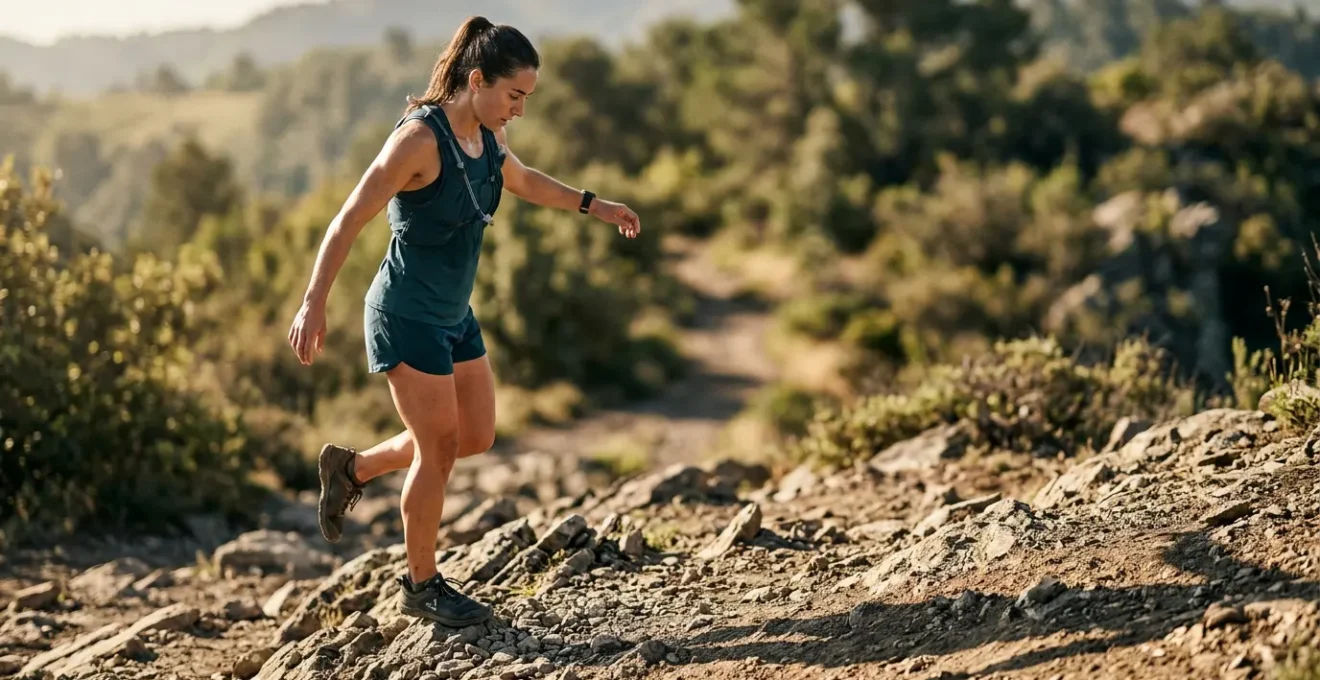
From a purely proprioceptive standpoint, trail running is the superior environment for building ankle stability. The constantly varying, unpredictable surfaces—rocks, roots, inclines, and declines—force the foot and ankle to make thousands of micro-adjustments per minute. This is the ultimate real-world training for reactive stability, sharpening the neuromuscular system in a way a perfectly flat, predictable surface never can. The treadmill, by contrast, is a highly controlled environment that can, if used exclusively, detrain these vital protective reflexes.
However, this does not mean the treadmill is useless. For an athlete in the process of rehabilitation, the trail may present too much challenge too soon, risking re-injury. The treadmill offers a controlled space to progressively reintroduce load and complexity. With specific modifications, it can be a powerful tool for rebuilding the foundational components of ankle stability before returning to the trail.
Instead of simple forward walking or running, the treadmill can be used for targeted drills:
- Incorporate 2-minute intervals of backward walking at 1.5-2.0 mph to alter muscle firing patterns.
- Add lateral shuffles for 30 seconds every 5 minutes (holding the side rails for safety) to engage stabilizers in the frontal plane.
- Practice single-leg stance holds during the treadmill’s stop cycles to work on static balance under slight fatigue.
- Perform walking lunges on a 5-10% incline for 1 minute to challenge stability and strength simultaneously.
- Include periods of deliberate heel-to-toe walking to enhance proprioceptive feedback and motor control.
How to Use a Tennis Ball to Sharpen Your Reflexes at Home?
Static balance—standing on one leg—is the foundation, but it is not enough. Ankle sprains don’t happen when you are standing still; they happen during dynamic, unpredictable movements. To prevent these injuries, you need to train for reactive stability. This is the ability of your neuromuscular system to produce a fast, powerful, and unconscious contraction to protect the joint from an unexpected perturbation. This is where simple tools, like a tennis ball, become invaluable for bridging the gap between slow rehab exercises and the speed of sport.
Tennis ball drills train reactive stability – the fast, unconscious reflexes needed to prevent ankle sprains, bridging the gap between slow balance exercises and real-world speed requirements.
– Dr. Eric Hefferon, DPT, Impact Physical Therapy Guidelines
These drills introduce an element of chaos that forces your system to react. While you are consciously focused on catching the ball, your subconscious motor system is working overtime to maintain your balance, firing muscles in the correct sequence and with the correct force to keep you upright. This is the essence of functional neuromuscular training.
A progressive routine can be easily implemented at home:
- Level 1: Stand on one leg. Drop the ball in front of you and catch it with both hands before it bounces a second time. Repeat for 10 catches, 3 sets.
- Level 2: Stand on one leg and bounce the ball against a nearby wall, catching it on the rebound. Repeat for 15 catches, 3 sets.
- Level 3: Have a partner toss the ball to random positions—high, low, and to your sides—forcing you to reach and adjust while maintaining balance. Aim for 20 catches, 3 sets.
- Level 4: Add a head tracking component. Follow the ball with your eyes and head as it is tossed, further challenging your vestibular system.
- Level 5: Perform any of these drills while standing on a slightly unstable surface (like a foam pad) or while your eyes track a different, secondary moving object.
Key takeaways
- Recurring ankle sprains are primarily a neurological issue (faulty proprioception), not just a muscular one.
- Focus on floor-based balance first to give the brain clear signals for recalibration before using unstable surfaces.
- Chronic use of cushioned shoes and ankle braces can numb sensory feedback, worsening the problem over time.
Why Is ‘Bounce Back’ Ability More Important Than Peak Fitness?
In the world of athletics, we are often obsessed with metrics of peak performance: max lift, sprint speed, vertical jump. We celebrate peak fitness. Yet, this focus on power output misses a more critical component of usable, long-term athleticism: resilience. The ability to absorb unexpected forces, to recover from a stumble, to “bounce back” from the brink of an injury—this is the true hallmark of a robust athlete. A staggering systematic review data shows that up to 46% of individuals with a history of an ankle sprain go on to develop chronic ankle instability. This is not a failure of fitness; it is a failure of resilience.
The entire system of proprioceptive re-education detailed in this article is designed to build this resilience. It is about creating a buffer zone. A finely tuned sensory-motor system gives you a larger margin for error. It detects a dangerous joint position sooner, initiates a protective muscle contraction faster, and makes subtle corrections so efficiently that you may not even consciously register the near-miss. This is your “bounce back” ability in action.
True, usable fitness is not just about power output. It’s about having a sophisticated sensory-motor system that can effectively manage that power in a chaotic world.
– McKeon et al., The effect of sensory-targeted ankle rehabilitation strategies
This shifts the goal of training. Instead of just asking “How much stronger can I get?” the question becomes “How much more adaptable and responsive can my system become?” A high-performance engine is useless if the steering and suspension are shot. By focusing on rebuilding your body’s GPS, you are investing in the steering and suspension that will allow you to safely use your engine for years to come.
The path to durable, resilient ankles requires a shift in mindset from hardware to software. Begin the process of recalibrating your neuromuscular system and rebuilding your brain’s trust in your body today.