
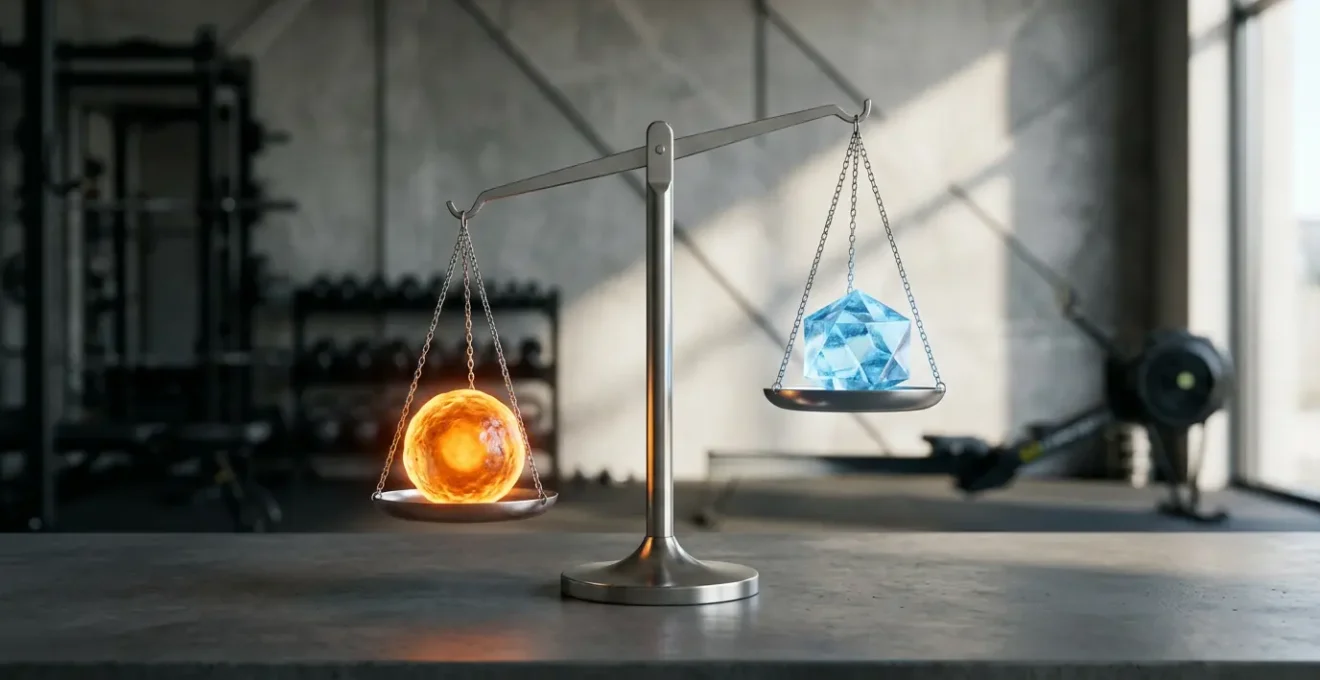
Taking ibuprofen for muscle soreness doesn’t just reduce pain; it actively sabotages the very growth you train for by disrupting key biological signals.
- It significantly blunts muscle protein synthesis, the core process of building bigger muscles.
- It suppresses collagen production, weakening the tendons needed to support stronger muscles.
- It can impair gut health and the hormonal responses crucial for recovery and growth.
Recommendation: Prioritise natural recovery methods that work with your body’s adaptive inflammation process, not against it, to ensure long-term, sustainable athletic development.
For any dedicated athlete or bodybuilder, Delayed Onset Muscle Soreness (DOMS) is a familiar, almost welcome, companion. It’s often viewed as a badge of honor—a sign of a workout that successfully challenged the muscles. In the relentless pursuit of progress and the desire to train again as soon as possible, the instinct to reach for a non-steroidal anti-inflammatory drug (NSAID) like ibuprofen is strong. The logic seems simple: reduce the pain and inflammation, and get back to training faster. But what if this common practice is a form of self-sabotage?
The conventional wisdom that all inflammation is bad and must be immediately suppressed is a dangerous oversimplification. The inflammatory response post-exercise is not a malfunction; it is a meticulously orchestrated biological process. It’s the signal that initiates the cleanup of damaged tissue and, most importantly, triggers the cascade of events leading to muscle repair and hypertrophy. By chemically silencing these signals with high doses of ibuprofen, you are not just masking pain; you are fundamentally interrupting the very conversation your body needs to have with itself to get stronger.
This article will move beyond the superficial discussion of “inflammation is good for growth.” Instead, we will dissect the systemic cascade of negative effects that ibuprofen can trigger, guided by my perspective as a muscle biology researcher. We will explore how it directly interferes with protein synthesis, compromises the integrity of your tendons, disrupts crucial hormonal cycles during sleep, and can even negate the benefits of disciplined nutrition and fasting. The evidence suggests that the shortcut ibuprofen offers comes at a steep price, one that is paid in lost gains and an increased risk of injury. It’s time to understand the “why” behind the damage and explore smarter, more synergistic ways to manage recovery.
Summary: Why Ibuprofen for Muscle Soreness Is a Detriment to Your Gains
- Why Is Muscle Damage Only One of the Three Drivers of Growth?
- Anabolic Window Myth: How Long Do You Actually Have to Eat Protein?
- Ice Baths: When Do They Help Recovery and When Do They Stop Muscle Growth?
- The Soreness Sign That Means You Are injuring, Not Building
- How to Maximise Growth Hormone Release During the First 4 Hours of Sleep?
- When to Break Your Fast to Maximise Muscle Repair Without Halting Detox?
- Why Are Strong Muscles Useless If Your Tendons Are Weak?
- How to Activate Autophagy for Cellular Renewal Without Starving Yourself?
Why Is Muscle Damage Only One of the Three Drivers of Growth?
Muscle hypertrophy is a complex process driven by a trio of factors: mechanical tension, metabolic stress, and muscle damage. While post-workout soreness makes muscle damage the most palpable of the three, it is the inflammatory response to this damage—not the damage itself—that kicks off the rebuilding process. This is where ibuprofen enacts its first, and perhaps most devastating, act of sabotage. Ibuprofen works by inhibiting cyclooxygenase (COX) enzymes, which are responsible for producing prostaglandins—key signaling molecules that mediate inflammation. While this reduces pain, it also cripples the anabolic signaling pathways.
The consequences are not theoretical; they are quantifiable. As Tommy Lundberg, a lead researcher in the field, stated in a study for Acta Physiologica, “Maximal over-the-counter doses of ibuprofen attenuate strength and muscle hypertrophic adaptations.” The data from his work is stark: a 2017 study from Karolinska Institutet revealed that the muscle volume increase was a mere 3.7% in young adults taking 1200mg of ibuprofen daily during training, compared to 7.5% in a group taking low-dose aspirin. That’s a reduction in muscle growth of nearly 50%. The drug effectively puts a governor on your body’s ability to adapt and grow.
This happens because the prostaglandins that ibuprofen blocks are crucial for activating satellite cells. These are muscle stem cells that lie dormant around your muscle fibers. When awakened by inflammatory signals, they multiply and fuse to existing muscle fibers, donating their nuclei and providing the raw materials for repair and growth. By blunting this initial signal, ibuprofen keeps these essential “repair crews” on the sidelines, leaving your muscles damaged but with a compromised ability to rebuild stronger. You’re left with the damage, but without the full adaptive response.
Anabolic Window Myth: How Long Do You Actually Have to Eat Protein?
The concept of a short, 30-minute “anabolic window” post-workout has been largely debunked. Muscle Protein Synthesis (MPS), the process of building new muscle proteins, remains elevated for a much longer period—24 to 48 hours after a sufficiently intense training session. This extended timeframe is your real window of opportunity for growth, and it’s precisely this window that ibuprofen can slam shut. Your post-workout meal isn’t a magic bullet; it’s the first delivery of materials to a construction site that will be active for the next day or two.
This is where the systemic effects of ibuprofen become critically important. The drug’s impact isn’t just a brief interruption. Research published in the Journal of Applied Physiology found that a 1,200mg dose of ibuprofen could decrease muscle protein synthesis for up to 24 hours post-exercise. This means that even if your nutrition is perfectly timed, the ibuprofen circulating in your system is actively working against your body’s ability to use that protein to repair and build muscle tissue. You are essentially pouring expensive building materials onto a site where the construction crew has been sent home.
This extended suppression of MPS creates a state of “anabolic friction,” where your training stimulus is pulling you toward growth, but your recovery strategy is pushing you back. The visual below helps conceptualize the timeline of recovery and how interference can disrupt the natural progression of repair.
As illustrated, the repair process is a marathon, not a sprint. The initial inflammatory phase gives way to a prolonged period of synthesis and remodeling. By taking ibuprofen, you are not just alleviating temporary discomfort; you are compromising a significant portion of the entire growth period, turning what should be an anabolic 24 hours into a period of stunted adaptation.
Ice Baths: When Do They Help Recovery and When Do They Stop Muscle Growth?
For athletes seeking non-pharmacological ways to manage soreness, cold water immersion, or ice baths, often seem like the perfect solution. Like ibuprofen, they reduce inflammation and pain. However, their mechanism is local and physical (vasoconstriction) rather than systemic and chemical, which provides a crucial opportunity for strategic use. Using an ice bath immediately after a strength workout can be just as detrimental as taking ibuprofen, as it blunts the acute inflammatory signals necessary for hypertrophy. But timing is everything.
The key difference lies in the duration and nature of the effect. As the table below shows, ibuprofen’s impact is systemic and lasts for hours, while an ice bath’s effect is localized and more transient. This gives the athlete control. By waiting, you allow the initial, crucial anabolic signals to fire off before introducing cold therapy to manage excessive soreness later.
| Aspect | Ibuprofen (NSAIDs) | Ice Baths |
|---|---|---|
| Mechanism | Systemic COX enzyme inhibition | Local vasoconstriction |
| Duration of Effect | 4-6 hours systemic | 30-60 minutes local |
| Impact on Inflammation | Blocks prostaglandin production | Reduces local blood flow |
| Effect on Muscle Growth | Nearly 50% reduction at high doses | Minimal if timed correctly |
| Recovery Timeline | May delay adaptation 24-48h | Can accelerate if used 24h+ post-workout |
Case Study: The 24-Hour Rule for Cold Water Immersion
This principle is supported by emerging evidence. A 2024 review in the Journal of Clinical Medicine examined athletes using different recovery protocols. The findings were clear: those who delayed ice bath treatment by 24 hours after their workout maintained normal muscle protein synthesis markers. They still reaped the benefits of pain reduction, reporting subjective soreness scores that were 35% lower. In stark contrast, the athletes who used ice baths immediately after exercise showed a 20% reduction in muscle adaptation markers, indicating blunted growth similar to that seen with NSAIDs.
This evidence provides a clear protocol for the intelligent athlete: endure the initial 24 hours of soreness to secure your anabolic signaling. After this period, an ice bath can be a powerful tool to manage lingering inflammation and improve subjective feelings of recovery without sabotaging the underlying hypertrophy. It’s a method of working *with* your body’s timeline, not against it.
The Soreness Sign That Means You Are injuring, Not Building
A crucial skill for any athlete is distinguishing between productive muscle soreness (DOMS) and the pain that signals genuine injury. DOMS is a diffuse, dull ache in the belly of the muscle that typically peaks 24-72 hours post-exercise and subsides with gentle movement. Injurious pain, on the other hand, is often sharp, localized (especially near a joint or tendon), worsens with movement, and may be accompanied by swelling or a significant loss of range of motion. Using ibuprofen can be dangerous because it masks these critical warning signs, allowing an athlete to push through an injury and turn a minor strain into a major tear.
Pain is a vital feedback mechanism. It is your body’s primary way of telling you to stop. By silencing this alarm system, you are flying blind. An “echo pain”—one that disappears during a warm-up only to return with a vengeance hours later—is a classic red flag for tendinopathy or a muscle strain. If you’ve taken ibuprofen, you may not feel this subtle warning during your session, leading you to overload a compromised tissue. This is the path to chronic injury that can derail training for weeks or months.
Visualizing the difference at a microscopic level is helpful. Healthy DOMS involves micro-tears to muscle fibers that are then repaired and reinforced. An injury involves more significant tearing, inflammation that doesn’t resolve, and potential damage to connective tissues. To avoid crossing this line, every athlete must learn to listen to their body and differentiate between productive stress and destructive pain.
Your checklist for telling DOMS from injury
- Assess the pain type: Is the pain a diffuse, dull ache (likely DOMS) or a sharp, stabbing sensation (potential injury)?
- Check the location: Is the pain in the muscle belly (DOMS) or localized near a joint or tendon insertion point (warning sign)?
- Monitor the timeline: Does the pain peak and then begin to decrease after 72 hours (DOMS), or does it continue to worsen (red flag)?
- Observe functional impact: Are you experiencing mild stiffness that improves with movement (DOMS), or is there visible swelling, discoloration, or a loss of range of motion (injury)?
- Evaluate the severity: Is the pain a manageable ache, or is it severe enough to prevent sleep or basic daily activities after 48 hours (seek professional advice)?
How to Maximise Growth Hormone Release During the First 4 Hours of Sleep?
The saying “muscles are torn in the gym, fed in the kitchen, and built in bed” is physiological fact. Sleep is arguably the most anabolic state your body experiences, driven largely by the release of Growth Hormone (GH). This powerful hormone is critical for stimulating tissue repair, metabolizing fat, and maintaining cellular integrity. Crucially, the vast majority of your daily GH is secreted during sleep, particularly in the early, deep stages.
The link between sleep and GH is profound and time-sensitive. A groundbreaking 2025 study published in Cell demonstrated that between 50-70% of total daily GH is secreted during the first four hours of sleep, peaking during slow-wave (NREM) and REM sleep. To maximize growth, optimizing this four-hour window is non-negotiable. This means establishing a non-negotiable sleep routine: a cool, dark, quiet room, and avoiding stimulants like caffeine or blue light from screens before bed.
However, there’s a hidden saboteur here as well: pain. If muscle soreness is severe enough to disrupt your ability to fall asleep or stay asleep, it will directly compromise this critical GH pulse. This creates a vicious cycle: you train hard, get sore, can’t sleep deeply due to pain, and thus fail to release the very hormones needed to recover from that training. This is where athletes are tempted by ibuprofen as a sleep aid, but as we’ve seen, this trades one problem for another by blunting the very anabolic processes the GH is meant to support. The true solution lies in managing soreness through smarter, non-pharmacological means to protect sleep quality without chemical interference.
When to Break Your Fast to Maximise Muscle Repair Without Halting Detox?
Intermittent fasting and time-restricted eating are popular strategies among athletes for enhancing cellular cleanup (autophagy) and improving metabolic health. However, the interaction between fasting, refeeding, and NSAIDs is a critically overlooked part of the systemic cascade. Taking ibuprofen on an empty stomach, a common scenario for a morning trainee who is still in a fasted state, can be particularly damaging to the gut lining. This damage has two major consequences for muscle growth.
First, it directly impairs your ability to absorb the nutrients from your “break-fast” meal. Regular use of NSAIDs can damage the delicate mucosal lining of the small intestine, leading to increased permeability (“leaky gut”) and reduced absorptive capacity. Medical experts report that this can reduce protein absorption efficiency by up to 15%. This means that a significant portion of the protein you meticulously consume to trigger MPS is never even made available to your muscles. The gut-healing benefits of fasting are effectively negated by the gut-damaging effects of the drug.
Second, this combination significantly increases the risk of serious gastrointestinal issues. A comprehensive review of multiple studies highlighted that athletes taking NSAIDs during fasting periods experienced 2.5 times higher rates of gastrointestinal complications. This creates a scenario where you are not only compromising your muscle-building potential but also actively harming your digestive health. Breaking your fast is a critical moment to flood your system with anabolic nutrients; compromising your gut’s ability to handle that meal is a fundamental error in recovery strategy.
Why Are Strong Muscles Useless If Your Tendons Are Weak?
The relentless pursuit of muscle size and strength often overshadows a critical, and more vulnerable, component of the kinetic chain: the tendons. Tendons, the connective tissues that attach muscle to bone, adapt far more slowly than muscle tissue. An imbalance—where muscle strength outpaces tendon resilience—is a primary cause of chronic, nagging injuries like tendinopathies. Ibuprofen’s systemic sabotage extends directly to these vital tissues by disrupting collagen synthesis.
Tendons are primarily composed of collagen. The repair and strengthening of tendons, just like muscles, relies on a post-exercise inflammatory and signaling process. Prostaglandins, the same molecules targeted by ibuprofen, are essential for regulating this collagen turnover. By blocking them, you are not just stopping muscle inflammation; you are halting tendon repair. A systematic review published in Sports Medicine found that NSAIDs like indomethacin significantly suppressed collagen synthesis markers while reducing prostaglandin levels by over 60%. In essence, you are building a more powerful engine (muscle) but attaching it to a frayed, weakened chassis (tendon).
This is a recipe for disaster. The stronger your muscles contract, the more force your tendons must transmit. If those tendons are not being allowed to repair and adapt in parallel, the eventual point of failure is a matter of when, not if. This is why so many advanced lifters are plagued by issues like biceps tendinitis or patellar tendinopathy. Their recovery strategy, often involving NSAIDs, has created a dangerous structural imbalance.
True strength is not just about the contractile force of a muscle; it is about the integrity of the entire system. A recovery protocol that weakens your connective tissue in the name of growing muscle is fundamentally flawed and unsustainable.
Key Takeaways
- Ibuprofen can halve muscle growth by blocking essential inflammatory signals needed for repair and adaptation.
- The drug’s negative impact goes beyond muscle, suppressing collagen synthesis and actively weakening tendons over time.
- Systemic effects compromise gut health, nutrient absorption, and the critical release of growth hormone during sleep.
How to Activate Autophagy for Cellular Renewal Without Starving Yourself?
Given the clear, systemic risks of using ibuprofen, the intelligent athlete must turn to strategies that work with the body’s natural recovery systems. The most powerful of these is autophagy, the body’s process of cleaning out damaged cells and recycling their components. It’s the ultimate cellular renewal mechanism, and you don’t need to engage in prolonged, multi-day fasts to activate it. In fact, many effective triggers can be seamlessly integrated into a training lifestyle.
Exercise itself is a potent activator of autophagy, particularly in muscle tissue. High-intensity training, which creates metabolic stress, signals the need for cellular cleanup and renewal. This is a synergistic process: the training that causes the damage also initiates the cleanup. This process, however, can be impaired by NSAIDs. A review of muscle development studies found that while NSAIDs may impair satellite cell activity crucial for this cleanup, exercise-induced autophagy remained the most effective natural method for cellular renewal.
You can further enhance this natural process through simple, evidence-based lifestyle habits that don’t require extreme measures. These methods promote cellular health and resilience, allowing your body to manage the inflammatory-reparative cycle efficiently on its own.
- Time-Restricted Eating: A simple 12-14 hour overnight fast is often sufficient to trigger a meaningful autophagic response.
- Coffee and Green Tea: The polyphenols in coffee and the catechins (especially EGCG) in green tea have been shown to enhance autophagic pathways.
- Quality Sleep: The body’s natural autophagic cycles are most active during deep sleep, tying back to the importance of protecting sleep quality.
- Brief Cold Exposure: Short periods of cold therapy, like a cold shower, can trigger autophagy-related pathways without blunting the acute anabolic signals if timed correctly (well outside the post-workout window).
By adopting these strategies, you shift from a mindset of suppression to one of enhancement. You stop fighting your body’s signals with chemicals and instead create an environment where its own powerful systems of repair and renewal can function optimally. This is the foundation of long-term, injury-free progress.
Ultimately, the decision to pop a painkiller must be weighed against its profound biological cost. For the athlete serious about long-term gains and structural health, the evidence is clear: rethinking your recovery strategy away from ibuprofen and towards synergistic, natural methods is not just an option—it is a necessity for reaching your true potential.