
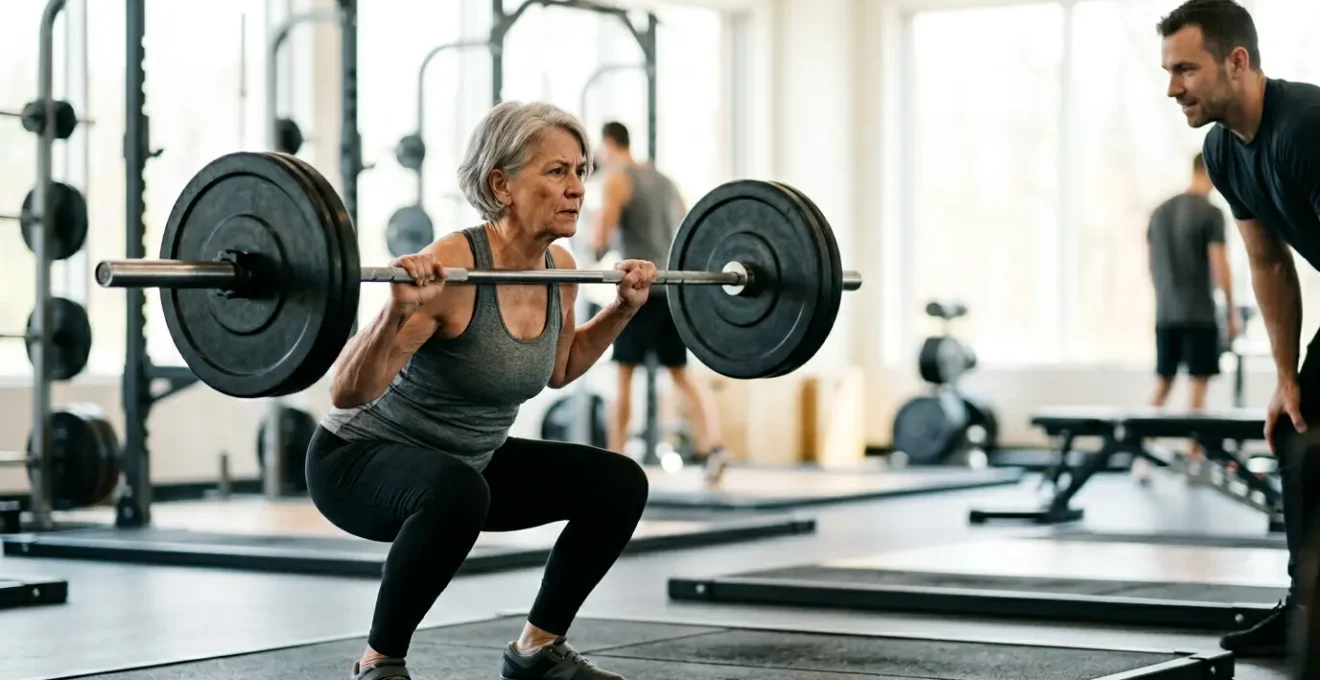
Contrary to popular belief, gentle exercise like walking is not enough to secure your future independence; the key lies in safely and progressively lifting heavy weights.
- The real risk isn’t injury from lifting, but the inevitable decline from muscle and bone density loss (sarcopenia and osteoporosis).
- Lifting challenging weights sends the necessary signals to your body to build strength, improve balance, and protect against falls and fractures.
Recommendation: Shift your focus from low-intensity cardio to a structured strength training programme that prioritises progressive overload for a stronger, more resilient future.
If you’re over 50, you may have noticed subtle changes. Perhaps getting up from a low sofa requires an extra push, or carrying a full shopping basket feels more strenuous than it used to. The common advice we hear is to stay active, with walking often praised as the gold-standard, low-risk activity. It’s gentle, accessible, and certainly better than being sedentary. But what if this well-meaning advice is dangerously incomplete? What if the very thing you fear—lifting something heavy—is actually the safest and most effective path to preserving your freedom and vitality for decades to come?
This isn’t about becoming a bodybuilder. It’s about understanding a fundamental biological truth: without a strong enough stimulus, our bodies enter a managed decline. Age-related muscle loss, or sarcopenia, isn’t a passive process; it’s an active adaptation to a lack of demand. The fear of getting hurt in the gym is understandable, but it leads many to choose activities that, while beneficial for cardiovascular health, fail to address the foundational pillars of independence: muscle strength and bone density. The real, unspoken danger is not the single event of an injury, but the slow, silent erosion of your physical capabilities.
In this guide, we will dismantle the myth that “light and easy” is the safest option. As your coach, I will show you why your body needs to be challenged to thrive. We will explore why the strength of your handshake is a powerful health marker, why light “pink dumbbells” won’t protect your bones, and how to safely begin a journey that will empower you to stand up without assistance, carry your grandchildren with confidence, and live life on your own terms. It’s time to reframe risk and discover the profound safety that true strength provides.
This article will guide you through the essential principles of building and maintaining strength as you age, providing a clear roadmap to a more resilient and independent future. Explore the sections below to understand the science and the practical steps you can take.
Table of Contents: Why Building Strength is Your Best Defence
- Why You Lose 3-5% of Muscle Mass per Decade After 30 Without Intervention?
- Machines or Dumbbells: Which Is Safer for a 60-Year-Old Beginner?
- Why Is Your Handshake Strength a Predictor of All-Cause Mortality?
- The ‘Pink Dumbbell’ Mistake That Fails to Stimulate Bone Density
- How to Overcome Anabolic Resistance with Higher Protein Breakfasts?
- Why Can’t You Stand Up Without Hands anymore?
- Why Do You Need High-Impact Jumping to Signal Bone Growth?
- Why Your Daily Walk Is Not Enough to Protect Your Hips from Fracture?
Why You Lose 3-5% of Muscle Mass per Decade After 30 Without Intervention?
The gradual loss of strength and vitality after 30 isn’t just a feeling; it’s a physiological process called sarcopenia. It’s the age-related, involuntary loss of skeletal muscle mass and strength. While the 3-5% figure is often cited, research confirms the trend, with some data suggesting an 8% muscle mass decline per decade after age 30, a rate that can accelerate significantly after 60. This isn’t just about looking less toned; it’s the root cause of increased frailty, a slower metabolism, and a reduced ability to perform everyday tasks.
Think of your muscles as your body’s metabolic engine and armour. They burn calories even at rest, help regulate blood sugar, and provide the power and stability to move confidently and avoid falls. When muscle mass declines, this engine sputters. Your metabolism slows, making weight management more difficult, and your physical resilience diminishes. It’s a “use it or lose it” scenario in its most literal sense. The body, being ruthlessly efficient, simply stops maintaining tissue that isn’t being regularly challenged.
The primary drivers of this decline are twofold: a decrease in the nerve signals that tell your muscles to contract and a hormonal shift that makes it harder to build new muscle tissue (a concept we’ll explore later as ‘anabolic resistance’). Without the powerful stimulus of resistance training, your body receives no compelling reason to maintain costly muscle fibres. The good news? This process is not inevitable. It’s highly responsive to intervention, and the most powerful intervention we have is picking up something heavy.
Machines or Dumbbells: Which Is Safer for a 60-Year-Old Beginner?
Entering a gym for the first time can feel intimidating, with rows of complex machines and racks of free weights. The most common question I hear is, “Where do I even start?” For someone over 50 concerned about safety, the choice between resistance machines and dumbbells is crucial. There is no single “best” answer; instead, it’s about understanding the trade-offs and choosing the right tool for your current ability and long-term goals. Machines offer a fixed path of motion, which provides stability and isolates specific muscle groups. This makes them an excellent and safe starting point for beginners.
This image demonstrates the kind of supportive environment where you can learn safely. Notice the controlled posture and the presence of a guiding hand, ensuring the movement is both effective and secure.
The machine provides the stability, allowing you to focus entirely on learning the sensation of contracting the target muscle without worrying about balance. Dumbbells, on the other hand, require you to stabilise the weight yourself. This recruits more supporting muscles and has a greater “functional transfer” to real-life activities, like lifting a bag of soil in the garden. However, they also have a steeper learning curve and a higher initial risk if form is incorrect.
A sensible approach often involves starting with machines to build a base level of strength and confidence. As your technique and strength improve, you can progressively incorporate dumbbells to challenge your stability and coordination. The following table breaks down the key differences to help you make an informed decision with your coach or trainer.
| Factor | Machines | Dumbbells |
|---|---|---|
| Stability | Fixed path, lower balance requirement | Requires core stabilization |
| Learning Curve | Easier for beginners | Requires technique mastery |
| Functional Transfer | Limited real-world application | Mimics daily activities |
Why Is Your Handshake Strength a Predictor of All-Cause Mortality?
It may sound strange, but the firmness of your handshake is one of the most reliable and well-researched indicators of your overall health and longevity. It’s not the handshake itself that’s magical; it’s what it represents. Grip strength is a proxy for your total-body muscle strength. If your grip is weak, it’s highly likely that the major muscle groups in your legs, hips, and core—the ones responsible for keeping you upright and mobile—are also weak.
Researchers have studied this connection extensively. A weak grip is consistently linked to a higher risk of cardiovascular events, disability, and premature death from all causes. It’s a simple, non-invasive vital sign that tells a powerful story about your body’s resilience. When you can no longer open a stubborn jar or carry your shopping bags with ease, it’s a clear signal that your functional independence is at risk. This loss of strength doesn’t happen overnight; it’s the result of years of sarcopenia taking its toll.
The empowering takeaway from this research is that strength is protective. A landmark 2024 study confirmed that for people with an average age of 70, any amount of weight training lowered all-cause, cardiovascular, and cancer mortality. Building strength isn’t just about feeling good; it’s a direct investment in a longer, healthier life. As the UCLA Health Research Team notes, “Strength training has significant benefits for older adults. It may reduce the risk of osteoporosis, increase muscle strength and reduce the risk of death.” Every exercise that improves your strength—from a deadlift to a simple farmer’s walk holding heavy dumbbells—is actively improving your grip and, by extension, fortifying your entire body.
The ‘Pink Dumbbell’ Mistake That Fails to Stimulate Bone Density
Many people, particularly women, are advised to lift light weights to “tone up” and avoid “bulking up.” This is the “pink dumbbell” philosophy, and while it’s better than nothing, it’s a critical mistake for long-term bone health. Your bones, much like your muscles, are living tissues that adapt to the loads placed upon them. To trigger the bone-building process, you need to apply a force that is significantly greater than what your body experiences in daily life. This is called progressive overload.
This is especially critical for women. According to research, women can lose up to 20% of their bone mineral density in the first five to seven years following menopause. This dramatic loss makes them vulnerable to osteoporosis and devastating fractures, particularly of the hip. Walking and lifting very light weights simply do not create enough mechanical stress—or “effective stimulus”—to signal to your bone cells that they need to get stronger. It’s like gently tapping on a brick wall and expecting it to get thicker.
To build dense, resilient bone tissue like that shown above, you must send a powerful signal. You need to lift weights that are genuinely challenging for you. This doesn’t mean starting with a dangerously heavy weight; it means starting with a manageable weight and consistently working to increase it over time. The goal is to challenge your muscles to the point of fatigue in a set of, for example, 5-8 repetitions. This level of intensity is what tells your body, “We need to fortify this structure!”
Case Study: High vs. Low Intensity for Bone Health
Research directly comparing High-Intensity Resistance Training (HIRT) with Low-Intensity Resistance Training (LIRT) provides clear evidence. Studies have found that HIRT, which involves lifting heavier weights for fewer repetitions, is significantly more effective for increasing Bone Mineral Density (BMD) in older adults. The optimal protocol involves lifting the weight with intent (rapidly, but under control) and then lowering it slowly. This combination of force and control creates the powerful mechanical and hormonal signals needed to stimulate the cells responsible for building new bone.
How to Overcome Anabolic Resistance with Higher Protein Breakfasts?
As we age, our bodies become less efficient at converting the protein we eat into new muscle tissue. This phenomenon is known as anabolic resistance. It means that to achieve the same muscle-building response as a younger person, an older adult needs two things: a stronger stimulus from exercise (heavier weights) and a higher intake of protein, particularly at the right times. Simply put, the 30 grams of protein that might have been optimal for you at age 30 is no longer enough to maximally stimulate muscle synthesis at age 60.
One of the biggest mistakes people make is “back-loading” their protein intake, having a small, carb-heavy breakfast and lunch, followed by a large, protein-rich evening meal. Due to anabolic resistance, your body can only use a certain amount of protein for muscle repair at one time. The rest is largely wasted from a muscle-building perspective. A far more effective strategy is to distribute your protein intake evenly throughout the day, starting with a high-protein breakfast. This kick-starts muscle protein synthesis early and keeps it elevated.
Aiming for at least 25-30 grams of protein at breakfast sends a powerful signal to your body to switch from a state of muscle breakdown (which occurs overnight) to muscle building. This doesn’t have to be complicated or involve expensive supplements. It can be as simple as making smart swaps in your current routine. Here are a few practical examples:
- Instead of toast with jam, opt for two whole eggs with a slice of whole-grain toast.
- Swap your regular cereal for Greek yoghurt or Skyr with berries and a handful of nuts.
- Add a scoop of protein powder and a spoonful of nut butter to your morning porridge.
- Consider adding smoked salmon or cottage cheese to your scrambled eggs.
Why Can’t You Stand Up Without Hands anymore?
The ability to rise from a chair without using your hands is something most of us take for granted for decades. Then one day, you find yourself needing to push off the armrests. This is not a trivial sign of ageing; it is a critical indicator of declining lower-body and core strength. This single movement, the “chair stand,” is a fundamental test of functional independence. Losing this ability is a direct precursor to losing the ability to get off the toilet unaided, get out of a car with ease, or get up from the floor after a fall.
The problem is widespread. Data from the National Institute on Aging suggests that nearly 30% of adults older than 70 have trouble with everyday mobility, including the simple act of standing from a seated position. The reason is a loss of strength in the key muscles involved: the quadriceps (front of the thighs), the glutes (buttocks), and the core muscles that provide stability. Years of insufficient challenge have allowed these crucial muscles to weaken to the point where they can no longer handle your own body weight through a full range of motion.
The good news is that this is one of the most trainable abilities there is. You are not destined to rely on your arms forever. By systematically strengthening these muscles, you can reclaim this vital piece of your independence. The “box squat,” which is essentially a controlled sit-to-stand movement, is a cornerstone of any effective strength programme for older adults. The key is to start where you are and progress safely.
Your Action Plan: Reclaiming the Chair Stand
- Establish a Baseline (Weeks 1-2): Start with your current ability. Sit in a sturdy chair and use the armrests as much as needed to stand up. Focus on a controlled movement. Perform 2 sets of 10 repetitions.
- Reduce Assistance (Weeks 3-4): Progress by placing your hands on your thighs. Use them for a gentle push, aiming to rely on them less and less. Increase to 3 sets of 10 repetitions.
- Go Hands-Free (Weeks 5-6): The goal. Cross your arms over your chest and focus on driving through your heels to stand. Control the descent back into the chair slowly. Aim for 3 sets of 8 quality repetitions.
- Increase the Challenge (Weeks 7-8): Once hands-free is mastered, add a two-second pause at the bottom, just before you stand up. This removes momentum and builds true strength. Perform 3 sets of 6 repetitions.
- Add Load (Week 9+): You are now ready for weight. Hold a light dumbbell or kettlebell (2-5kg) against your chest (a “goblet squat”) and perform the movement. This is how you build a buffer of strength for the future.
Why Do You Need High-Impact Jumping to Signal Bone Growth?
If lifting challenging weights is step one for bone health, step two involves something that may sound even more intimidating: impact. While high-impact activities are often feared, especially by those with joint concerns, a specific and progressive dose of impact is one of the most powerful signals you can send to your bones to grow stronger. Walking, swimming, and cycling are fantastic for your heart, but they lack the sharp, mechanical jolt needed to stimulate bone remodelling. Your bones respond to the *rate* and *magnitude* of force, not just the duration of movement.
Think of it like this: your bone cells (osteocytes) are like tiny motion sensors. A gentle, repetitive motion like walking is familiar and doesn’t trigger an alarm. However, a short, sharp impact from a controlled jump is a novel stimulus. It compresses the bone matrix, sending a powerful “red alert” to the body’s repair crew to come in and lay down new, denser bone tissue to fortify the structure against future impacts. This is the body’s adaptive mechanism at its finest.
Of course, safety is paramount. You don’t go from a sedentary lifestyle to jumping off a high box. The key is progressive impact loading. You start with movements that are very low-risk and gradually increase the intensity as your bones, muscles, and connective tissues adapt. This measured approach allows you to reap the benefits of impact without exposing yourself to undue risk.
Case Study: The Safe Path to Impact
A progressive impact protocol demonstrates how to introduce this stimulus safely. The journey begins with simple, forceful heel drops or stomping in place for 10-15 repetitions. After 2-3 weeks, you can progress to step-ups onto a low stair or box for 8-12 reps per leg, focusing on a firm foot plant. The next phase involves small hops in place, landing softly for 5-8 reps. Only after mastering these stages over several weeks would you advance to something like stepping down from a low box, controlling the landing to absorb the force. This gradual adaptation is the secret to making high-impact exercise safe and effective for bone health.
Key Takeaways
- Muscle loss (sarcopenia) is not inevitable; it’s a direct response to a lack of challenging resistance.
- Lifting weights that are genuinely heavy for you is the most effective signal to build both muscle and bone density.
- Functional strength, like the ability to stand from a chair, is a direct result of a consistent strength training programme.
Why Your Daily Walk Is Not Enough to Protect Your Hips from Fracture?
Walking is a wonderful activity. It’s excellent for mental health, cardiovascular fitness, and maintaining mobility. But when it comes to preventing a hip fracture, it’s like bringing a garden hose to a house fire. A hip fracture is rarely a spontaneous event; it is almost always the result of a fall. Therefore, the most effective prevention strategy is twofold: build bones that are strong enough to resist breaking, and develop the strength, balance, and coordination to prevent the fall from happening in the first place. Walking, unfortunately, does not adequately address either of these factors.
Falls are startlingly common. As NPR health reporting indicates, more than one in four older people have a fall each year, with a significant number leading to serious, life-altering injuries. Walking on a flat, predictable surface does little to prepare your body for the real world—an uneven pavement, a stray toy on the floor, a sudden need to change direction. The ability to recover your balance after a trip requires fast-twitch muscle fibres and a strong core, attributes that are primarily built through resistance training, not steady-state cardio.
Furthermore, as we’ve discussed, the low-impact nature of walking does not provide the necessary stimulus to significantly increase bone density in the hip. You need the powerful combination of heavy lifting (like squats and deadlifts) and progressive, controlled impact to truly fortify that critical area. Emily Socolinsky, a gym owner who specialises in training older adults, puts it perfectly:
Walking for bone strength is like polishing a car’s paintwork while ignoring the engine. It looks good, but it won’t prevent a breakdown.
– Emily Socolinsky, Fivex3 Training Gym Owner
This powerful analogy captures the core message. To truly protect yourself, you must look beyond the surface-level benefits of gentle exercise and focus on building the powerful engine of muscle and bone that will carry you safely through life. It’s time to embrace strength training not as a risk, but as the ultimate form of self-preservation.
Now that you understand the principles, the next logical step is to build a safe and effective plan. Starting this journey under the guidance of a qualified coach can ensure your technique is correct and your programme is tailored specifically to your needs and goals, maximizing safety and results.
Frequently Asked Questions about Strength and Impact Training
Is impact exercise safe for people with osteoarthritis?
For many, it can be. When properly progressed, low-impact resistance training and carefully introduced impact exercises allow older adults, even those with conditions like arthritis, to engage in bone-building activities without exacerbating existing issues. The key is starting slowly and listening to your body, often under the guidance of a professional.
How much impact is needed to stimulate bone growth?
Research shows that forces equivalent to 4-5 times your body weight are optimal for bone stimulation. This may sound like a lot, but it is achievable through safe, progressive jumping and bounding exercises that are built up over time. You don’t start there, you work towards it.
What if I’ve never done impact exercise before?
That’s the most common starting point. The process should be gradual, beginning with simple bodyweight movements like forceful stomping or marching in place. You would then progress over an 8-12 week period to more dynamic movements, ensuring your bones, joints, and muscles have ample time to adapt safely.