
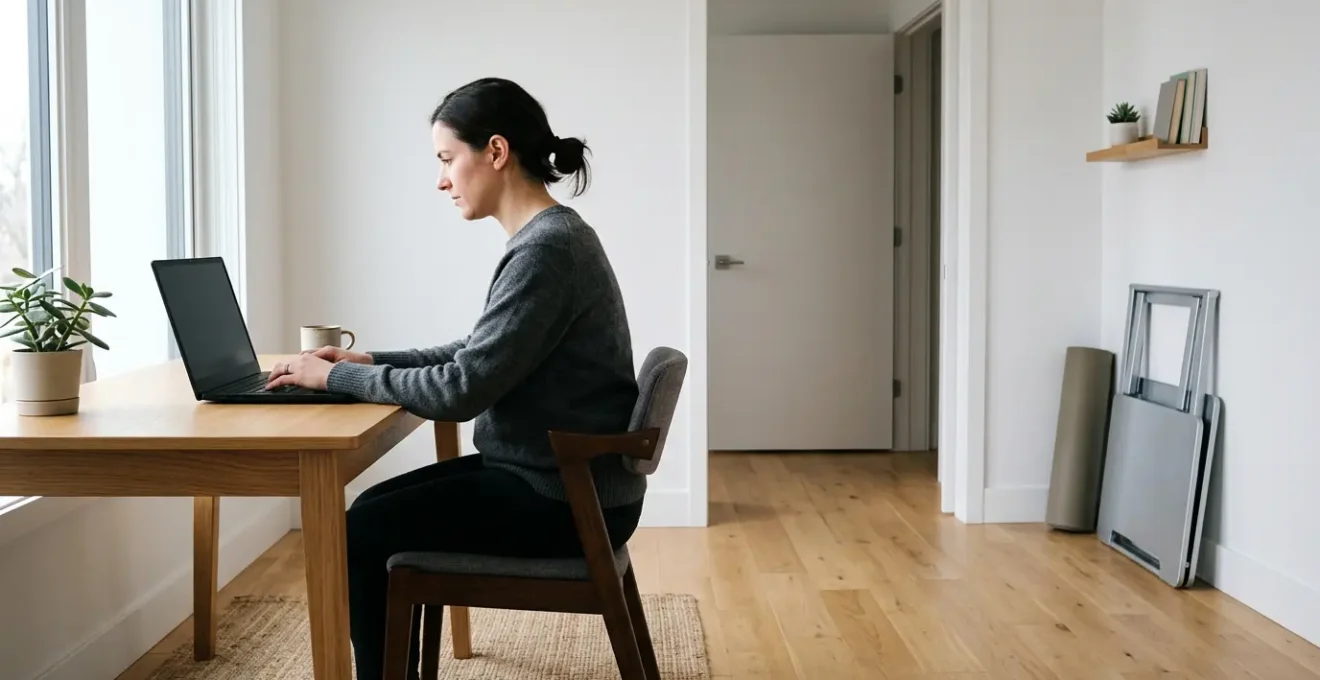
The aches, pains, and weight gain from working from home aren’t due to a single bad habit, but a systemic lack of movement your body was never designed for. The common advice to “buy a better chair” misses the point. This guide explains the hidden physiological damage of a static home office and provides a corrective framework, not based on willpower, but on redesigning your environment and routine to force constant, low-level activity that keeps your muscles and metabolism switched on.
The shift to remote work promised a new era of flexibility and work-life balance. You’ve reclaimed your commute time, you’re less stressed by office politics, and you can work in your sweatpants. Yet, a nagging reality is setting in for many: your body is starting to protest. It might be a persistent ache in your lower back, a stubborn few pounds that won’t shift, or a feeling of constant fatigue that a good night’s sleep can’t fix. You’ve tried the usual advice—getting an expensive ergonomic chair, setting up your monitor perfectly, maybe even a lunchtime workout—but the decline continues.
This is because we’ve been focusing on the wrong problem. The issue isn’t just poor ergonomics; it’s profound, all-day stillness. Your body is a dynamic machine built for movement, but the typical home office is a static cage. The health crisis of the Work-From-Home era isn’t about needing a better chair; it’s about the complete shutdown of critical physiological processes that a traditional office environment, with its walks to the conference room, coffee machine, and colleague’s desk, inadvertently kept alive.
What if the solution wasn’t to find the one “perfect” posture, but to embrace constant change? This guide moves beyond generic tips to reveal the specific, often invisible, damage being done to your muscles, metabolism, and spine. As an occupational therapist, my goal is to give you a corrective framework. We will explore the science behind why sitting is so destructive, how to design an environment that forces movement, and how to reactivate your body’s natural calorie-burning systems without needing to live in the gym.
This article provides a practical, evidence-based plan to reclaim your physical well-being. Below, you will find a breakdown of the core issues and the actionable strategies to counteract them, transforming your workspace from a source of pain into a tool for health.
Summary: Re-engineering Your WFH Setup for Health
- Why Does Sitting for 6 Hours Shut Down Your Leg Muscles’ Fat-Burning Enzymes?
- How to Design a Home Office That Forces You to Move More?
- Fake Commute or Morning Run: Which Best Separates Sleep from Work?
- The ‘Dead Butt’ Syndrome That Causes Lower Back Pain in Desk Workers
- How to Use the 20-20-20 Rule to Save Your Vision and Sanity?
- Why Your 1-Hour Spin Class Can’t Fix the Damage of 9 Hours at a Desk?
- Why Does Looking Down at Your Phone Add 27kg of Pressure to Your Spine?
- How to Increase Your Daily Calorie Burn Without Stepping Foot in a Gym?
Why Does Sitting for 6 Hours Shut Down Your Leg Muscles’ Fat-Burning Enzymes?
The most dangerous aspect of a desk job isn’t a sudden injury; it’s a silent, creeping shutdown happening at a microscopic level. In the large muscles of your legs and buttocks, you have crucial enzymes called Lipoprotein Lipase (LPL). Think of them as tiny metabolic switches responsible for pulling fat and triglycerides out of your bloodstream to be used for energy. When you are standing, walking, or engaging in even low-level activity, these enzymes are active and working for you. However, the moment you sit down, a catastrophic process begins.
The simple lack of muscle contraction from prolonged sitting sends a signal to these enzymes to go dormant. In fact, research indicates that after just 60-90 minutes of inactivity, the LPL enzymes in your leg muscles essentially “go to sleep,” causing their fat-burning activity to plummet. This means that even if you’re eating a healthy diet, the fat from your lunch isn’t being efficiently cleared from your bloodstream. Instead, it’s recirculated and more likely to be stored, contributing to weight gain, increased cholesterol levels, and a higher risk of metabolic syndrome.
The corrective protocol is simple but non-negotiable: you must interrupt the stillness. The key is frequency, not intensity. Standing up and moving for just 2-3 minutes every 30-60 minutes is enough to “wake up” these enzymes and reactivate your muscular metabolism. This isn’t about a full workout; it’s about preventing the shutdown in the first place. Simple actions like standing up during a phone call, doing a few calf raises while reading an email, or walking to the kitchen for water are powerful metabolic resets.
How to Design a Home Office That Forces You to Move More?
Relying on willpower to stand up every 30 minutes is a strategy doomed to fail. The moment you’re deep in focus, alarms are ignored and good intentions forgotten. A more effective, therapeutic approach is to create “environmental forcing functions”—designing your workspace so that movement is not an option, but a necessity. The goal is to build an environment where your daily tasks inherently require you to change posture, walk, reach, and bend. This begins by deconstructing the idea of a single, static workstation.
Instead of one “perfect” desk, create a distributed workspace with multiple zones. Your primary monitor and keyboard might be at a sitting desk, but your printer could be across the room. Your water bottle and notepad could live on a high shelf, forcing you to stand and reach. The charging station for your phone could be in a different room altogether. This purposeful distribution transforms simple tasks into opportunities for movement, breaking up periods of stillness without conscious effort.
The power of this approach is backed by research. The simple act of introducing an adjustable sit-stand desk can dramatically alter behavior, creating a new rhythm of work that alternates between sitting and standing postures throughout the day. This isn’t just a theory; it’s a proven intervention.
Case Study: The Minneapolis Take-a-Stand Project
The Minneapolis Take-a-Stand Project demonstrated that implementing sit-stand desks in office environments resulted in a drastic reduction in sitting time of up to 66 minutes daily. Workers using these adjustable desks experienced immediate postural improvements, reduced muscle fatigue particularly in the levator scapulae muscles (the ones that cause neck and shoulder tension), and reported increased engagement with their tasks along with improved perceived work performance.
Start by auditing your own space. What one item can you move today that would force you to get out of your chair at least a few times an hour? That small change is the first step in re-engineering your office for health.
Fake Commute or Morning Run: Which Best Separates Sleep from Work?
One of the most underrated benefits of the traditional workday was the commute. It created a clear, physical, and mental boundary between home life and work life. Without it, the line blurs, and we often find ourselves rolling out of bed and directly into work mode, or unable to switch off in the evenings. Recreating this boundary is essential for both mental health and physical activation. The question is, what’s the best way to do it: a “fake commute” or a structured workout like a morning run?
A morning run is excellent for cardiovascular health, but its primary function is exercise. A “fake commute”—a 15-20 minute walk around the block before you start your workday and after you finish—serves a different, arguably more important, purpose. It provides a low-intensity transition that signals to your brain and body that a shift is occurring. It exposes you to natural light, which helps regulate your circadian rhythm, improving both sleep quality and daytime alertness. It provides a moment for mental preparation or decompression that a high-intensity run, focused on performance, may not.
Ultimately, the choice depends on your goal. If the aim is purely physical fitness, the run wins. But if the goal is to create a sustainable, healthy structure for your remote work life, the fake commute is the superior tool. It’s an accessible, repeatable ritual that primes your body for the day and helps it wind down, preventing burnout and improving the work-rest cycle. The most powerful principle to adopt, however, is one of constant change, a philosophy perfectly captured by one ergonomics expert.
The best posture is the next posture.
– Karen Loesing, The Ergonomic Expert
Whether it’s a walk, a run, or simply moving between work zones, the key is to avoid stasis. Your body craves variety, and providing that transition is the first step to a healthier remote career.
The ‘Dead Butt’ Syndrome That Causes Lower Back Pain in Desk Workers
If you’re one of the up to 80% of office workers who experience lower back pain, the problem might not be in your back at all. The true culprit is often what’s happening—or not happening—in your gluteal muscles. Clinicians have a term for this condition: gluteal amnesia, more colloquially known as ‘Dead Butt Syndrome’. It’s a direct consequence of prolonged sitting, and it’s a primary driver of chronic lower back pain in the WFH population.
Here’s the mechanism: when you sit for hours on end, two things happen. First, your hip flexors, the muscles at the front of your hips, become short and tight. Second, your gluteal muscles, which are meant to be some of the most powerful in your body, become stretched and underactive. Your brain, in its efficiency, starts to “forget” how to fire them properly. This is gluteal amnesia. The muscles are not literally dead, but the neural pathway to activate them has become weak.
The consequence is a dysfunctional chain of movement. When your glutes don’t fire to help stabilize your pelvis and extend your hips (like when you stand up or walk), your body is forced to compensate. It recruits other, less-suited muscles to do the job—namely, your lower back muscles (erector spinae) and hamstrings. These muscles are not designed for this primary stabilization role. They become overworked, strained, and fatigued, leading to the familiar, persistent ache in your lumbar region. The pain is a symptom; the amnesia is the cause.
The corrective action involves two steps: first, regularly stand and stretch your hip flexors to release their tightness. Second, perform simple glute activation exercises—like glute bridges or bodyweight squats—during your work breaks. These exercises are not about building muscle mass, but about re-establishing that mind-muscle connection and reminding your brain that your glutes exist and have a critical job to do.
How to Use the 20-20-20 Rule to Save Your Vision and Sanity?
Staring at a screen for eight hours a day puts an immense strain on your visual system. The tiny ciliary muscles in your eyes are held in a constant state of contraction to focus on the near-field text and images on your monitor. This leads to a condition known as Digital Eye Strain (DES), with symptoms ranging from dry, itchy eyes and blurred vision to tension headaches. The 20-20-20 rule is the most prescribed antidote, but most people apply it incorrectly or inconsistently.
The rule is simple: every 20 minutes, take a 20-second break to look at something 20 feet (about 6 meters) away. This simple action allows the ciliary muscles to relax, preventing the fatigue and strain that builds up over time. The efficacy of this simple intervention is not just anecdotal; it’s backed by clinical evidence. A recent clinical study found that a 2-week implementation of 20-20-20 rule reminders via a software application led to significant improvements in the symptoms of dry eye among screen workers.
To truly make this rule effective, however, you must enhance it. Don’t just look away. Use the 20-second break as a full-body “micro-reset.” While you’re looking at your distant object, perform a gentle neck roll to release tension in your cervical spine. Shrug your shoulders up to your ears and then let them drop to combat tension in your trapezius muscles. Take a deep, diaphragmatic breath. Even better, stand up and perform a thoracic spine extension—a gentle upper back arch—to counteract the forward hunch of screen time. You can use automated reminder apps like ‘Eye Care 20 20 20’ to enforce the habit.
By “stacking” these small movements onto the 20-20-20 rule, you transform a simple eye-saving technique into a powerful tool for combating the broader postural and mental toll of desk work. It becomes a rhythmic, whole-body intervention that punctuates your day with moments of physical and mental release.
Key Takeaways
- Prolonged sitting (60+ mins) shuts down key fat-burning enzymes in your legs, disrupting your metabolism regardless of diet.
- Intense exercise for one hour cannot undo the damage of sitting for nine hours; constant, low-level movement is more effective.
- The best solution is not a single perfect chair or posture, but an environment and routine that forces frequent postural changes.
Why Your 1-Hour Spin Class Can’t Fix the Damage of 9 Hours at a Desk?
There’s a common and dangerous misconception among health-conscious remote workers: the belief that a vigorous one-hour workout can “cancel out” a full day spent sitting at a desk. You push yourself in a spin class or on a run, feel the burn, and assume you’ve done your duty for the day. From an occupational therapy perspective, this is a flawed view. While that workout is undeniably good for your cardiovascular system and mental health, it does not immunize you from the risks of a sedentary day. You can be what researchers call an “active couch potato” or, more accurately, practice dynamic sedentarism.
The term may sound contradictory, but it perfectly describes someone who meets or exceeds the recommended daily exercise guidelines but spends the vast majority of their remaining hours in a state of inactivity. As experts from Rise Physical Therapy note, “Even people who work out every day are still considered ‘sedentary’ if they spend the remainder of their time sitting.” The physiological damage from inactivity—the sleeping LPL enzymes, the tight hip flexors, the deactivated glutes—accrues hour by hour. A short, intense burst of activity is simply not enough to reverse the cumulative negative effects.
Think of it like this: your spin class is a powerful storm, but the rest of your day is a slow, relentless drought. The storm provides a temporary flood, but it can’t make the parched land fertile. Health is cultivated through consistent, gentle “watering” throughout the day, not a single daily deluge. Research shows that the benefits come from reducing total sitting time and increasing overall low-level activity. The goal isn’t just to be a person who exercises, but to be a person who is less sedentary overall. This means integrating movement into the 95% of your day that isn’t spent at the gym.
Why Does Looking Down at Your Phone Add 27kg of Pressure to Your Spine?
The modern posture is the forward head posture. We spend hours hunched over laptops and, even more destructively, looking down at our phones. This posture, often called “tech neck,” is not a minor aesthetic issue; it’s a biomechanical crisis for your cervical spine. Your head is heavy, weighing approximately 10-12 pounds (about 5kg) in a neutral position. But for every inch you tilt your head forward, the effective weight on your spine dramatically increases due to the simple physics of a lever arm.
When your head is tilted forward at just 15 degrees, the pressure on your cervical spine jumps to 27 pounds (12kg). At 30 degrees, it’s 40 pounds (18kg). At a 60-degree angle—a common posture when texting or browsing on a phone—you are asking the muscles, tendons, and ligaments of your neck and upper back to support the equivalent of 60 pounds (27kg) of pressure. That’s like carrying a small child on your neck for hours every day. This chronic overload leads to muscle strain, nerve compression, disc herniation, and persistent pain.
But the damage doesn’t stop at the neck. The body’s fascia creates a “superficial back line,” a continuous web of connective tissue from the base of your skull to the soles of your feet. As research on forward head posture demonstrates, tension in the neck creates a pulling effect along this entire chain. This can manifest as tension headaches, pain between the shoulder blades, and even contribute to conditions like plantar fasciitis. Furthermore, this hunched posture compresses your chest cavity, leading to shallow breathing patterns that reduce oxygen intake and can activate the body’s chronic stress response. The simple act of looking down at your phone has cascading, whole-body consequences.
The primary corrective action is awareness. Bring your phone up to eye level instead of dropping your head to meet it. When working on a laptop, use a separate keyboard and mouse and place the laptop on a stand so the top of the screen is at eye level. These small adjustments can dramatically reduce the pathological forces on your spine.
How to Increase Your Daily Calorie Burn Without Stepping Foot in a Gym?
The secret to managing your weight and metabolism while working from home isn’t about finding more time for the gym; it’s about harnessing the power of Non-Exercise Activity Thermogenesis (NEAT). NEAT is the energy expended for everything we do that is not sleeping, eating, or sports-like exercise. It includes the energy you burn walking to your car, typing, doing chores, fidgeting, and changing posture. For most people, NEAT is a far more significant contributor to daily calorie burn than a 30-minute workout.
The problem with a sedentary home office is that it decimates your NEAT. A traditional office had built-in NEAT: walking to the printer, going to a meeting room, visiting a colleague’s desk. At home, everything is within arm’s reach. Your mission is to consciously and systematically re-introduce NEAT into your day. This isn’t about “exercising”; it’s about being less efficient in your stillness. Small changes have a cumulative effect. For instance, Harvard research shows that you burn approximately 88 calories per hour while standing, compared to 80 while sitting. While a difference of 8 calories an hour seems trivial, over an 8-hour workday, five days a week, it adds up to over 8,000 extra calories burned per year—the equivalent of about 2.5 pounds of fat.
The key is to build a collection of NEAT-enhancing habits. Take phone calls while pacing around the room. Do a few squats while waiting for the kettle to boil. Hand-wash your lunch dishes instead of putting them in the dishwasher. Use a stability ball as a chair for 30-minute intervals to engage your core. Every extra movement, no matter how small, contributes to your total daily energy expenditure and helps keep your metabolism humming.
Your Action Plan: NEAT Enhancement for Home Workers
- Take all phone calls and virtual meetings (where you don’t need to present) while walking or pacing around your home.
- Place frequently used items like your water bottle or a notebook on a shelf that requires you to stand up and walk to retrieve them.
- Use work breaks to perform “movement snacks” or household chores: unload the dishwasher, fold laundry, or do 10 minutes of tidying.
- Set a timer for 10 minutes of pacing or light stretching for every hour of focused desk work, especially after meetings.
- Alternate your work position every 30-60 minutes: switch from sitting, to standing (if you have a standing desk), to even sitting on the floor for short periods.
By integrating these principles and actions into your daily routine, you move from passively accepting the health consequences of remote work to actively designing a workday that supports and enhances your physical well-being. Your next step is to choose one strategy from the action plan and implement it today.