
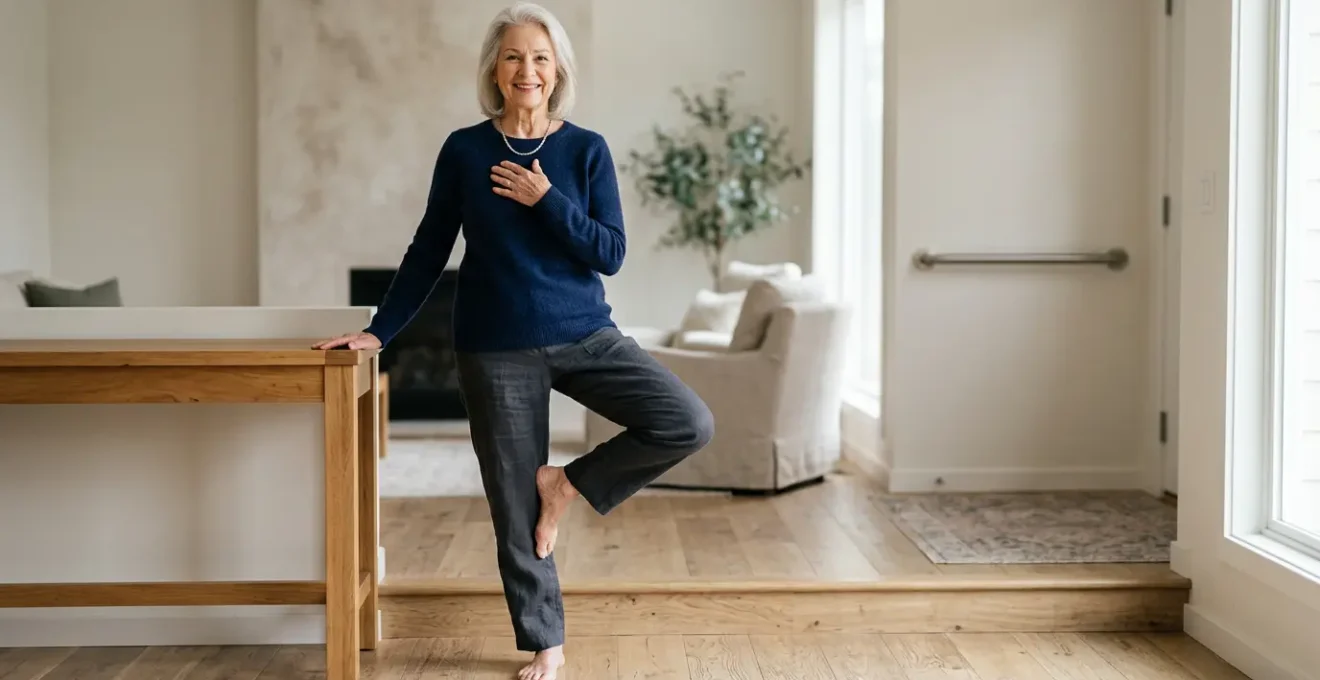
Contrary to common belief, the greatest threat to your stability isn’t a loose rug; it’s the fear of falling itself, which actively dismantles your body’s natural defenses.
- Fear creates “proprioceptive noise,” confusing the brain’s sense of balance and slowing your protective reflexes.
- Hidden risks in medications (like beta-blockers) and eyewear (like bifocals) can mimic feelings of instability, feeding the fear cycle.
Recommendation: Reclaim your independence by focusing on retraining specific systems—like the ‘stumble recovery’ reflex and floor-level strength—to de-link fear from your physical responses.
It is a paradox I have seen countless times in my work as a geriatric mobility specialist. An individual experiences a minor stumble, or perhaps witnesses a friend’s fall, and a seed of fear is planted. This fear, meant to be a protective instinct, grows until it becomes the very thing that puts them at greatest risk. They stop going for walks, avoid stairs, and limit their social life, believing that reducing activity will reduce their chances of falling. In reality, they have begun a dangerous cycle of “neuromuscular sabotage,” where fear actively degrades the physical systems designed to keep them upright.
The common advice—remove hazards, wear sensible shoes—is important, but it only addresses the external environment. It does nothing to combat the internal erosion of confidence and physical capability. This guide takes a different approach. We will go beyond the obvious to explore the intricate ways fear interferes with your body’s balance systems. We will look at how seemingly unrelated factors, from medications to sleep posture, contribute to this cycle. Most importantly, this article will provide practical, targeted strategies to break the cycle by retraining your body’s innate reflexes and rebuilding functional strength.
This isn’t about eliminating fear, but about understanding it and re-calibrating your body’s response. It’s about transforming anxiety into action, allowing you to regain not just your balance, but your freedom and independence. By focusing on the body’s specific mechanisms for stability, you can learn to trust your feet again.
In the sections that follow, we will explore the most critical areas for intervention, from identifying specific home hazards to training your reflexes and understanding the surprising link between your ability to sit on the floor and your overall longevity. Let’s begin the journey back to confident mobility.
Summary: Why the fear of falling is the biggest risk factor for falls
- Rugs or Ramps: What Are the Top 3 Trip Hazards in a UK Home?
- How to Train the ‘Stumble Recovery’ Reflex so You Don’t Hit the Floor?
- Beta-Blockers and Balance: Is Your Blood Pressure Med Causing Your Vertigo?
- The Bifocal Mistake That Distorts Depth Perception on Stairs
- Hip Protectors: Do These Undergarments Actually Prevent Breaks?
- How to Pillow-Prop Your Way to a Neutral Spine While Sleeping?
- How to ‘Fall-Proof’ Your Bathroom to Reduce Fracture Risk by 50%?
- Why Is Being Able to Sit on the Floor a Predictor of Your Lifespan?
Rugs or Ramps: What Are the Top 3 Trip Hazards in a UK Home?
While the fear of falling is an internal process, it is often triggered by the external environment. Your home, the place you should feel safest, can be filled with hidden risks that feed this anxiety. According to Age UK, a staggering 4.3 million older people worry about falling over, making it a primary concern that can lead to social isolation and physical decline. The key is not to become fearful of your surroundings, but to systematically identify and neutralize the most common threats. In the UK, certain features are particularly notorious for causing trips.
The top three hazards we consistently see are: loose rugs and worn carpets, especially those with curled edges; poor lighting, particularly in hallways and on staircases, which creates shadows that obscure steps or objects; and uneven transitions between rooms, such as raised thresholds or changes from carpet to hard flooring. Stairs are a major area of concern, as a recent analysis reveals that over 500,000 homes in England headed by someone over 55 have significant fall risks on the stairs alone. These hazards are not just physical obstacles; they are “proprioceptive noise,” confusing your brain’s ability to judge surfaces and distances.
Addressing these is the first practical step in breaking the fear cycle. It’s about creating an environment so predictable and safe that your brain can relax, reducing the hyper-vigilance that leads to stiff, unnatural movements. By methodically auditing your home, you take control and remove the environmental triggers that fuel the psychological fear.
Your 5-Point Home Safety Audit: From Pathways to Lighting
- Pathway Patrol: Walk your most-used routes (e.g., bed to bathroom). Identify and remove any low-level clutter, trailing electrical wires, or rug edges you must consciously step over.
- Transition Check: Examine every doorway and the transition between rooms. Are there uneven thresholds or significant changes in flooring texture that could catch a foot?
- Staircase Scrutiny: Assess your stairs in both daylight and at night. Are handrails secure on both sides? Are the edges of each step clearly visible, perhaps with contrast tape?
- Lighting Audit: Stand in each room and hallway at dusk. Can you reach a light switch *before* entering a dark space? Are there shadows cast across walking paths?
- Chair Challenge: Look at your favorite armchair. Can you stand up from it without pushing off with your hands? This assesses functional leg strength within your daily environment.
How to Train the ‘Stumble Recovery’ Reflex so You Don’t Hit the Floor?
Once your environment is safer, the next step is to retrain your body’s internal safety system: the stumble recovery reflex. This isn’t about having perfect balance all the time; it’s about what your body does in the split second you lose it. As we age, and especially when fear makes our movements hesitant, this reflex can slow down. The brain becomes so focused on *not falling* that it forgets how to *recover from a stumble*. We can, however, retrain this crucial, life-saving reaction through targeted exercises.
The goal is to re-teach your neuromuscular system to react instantly and automatically. Evidence-based training programs that include “perturbation” exercises—safely simulating unexpected losses of balance—can reduce fall risk significantly. While you shouldn’t create unsafe situations, you can practice movements that challenge your stability in a controlled way. Simple exercises, when done consistently, make a profound difference. In fact, research demonstrates that balance exercises can reduce fall risk by 23-24% in older adults by improving the speed and efficiency of these protective reflexes.
One of the most effective and safe exercises to practice at home is the “Clock Step” drill, which trains you to step quickly and confidently in multiple directions.
To perform this drill, imagine you are standing in the center of a large clock face. With a sturdy chair or countertop nearby for light support, practice stepping forward to 12 o’clock and returning to center. Then, step diagonally to 2 o’clock and return. Continue around the clock, stepping to 3, 4, 6, 8, 9, and 10 o’clock. The key is to keep your head up and your movements deliberate but fluid. This trains your brain and body to work together to regain balance, no matter which direction you are thrown off-kilter.
As this image illustrates, the exercise should be performed in an open space, using a chair for safety, not for support. This builds the functional strength and confidence needed to manage a real-world stumble. Start slowly, and as you become more confident, you can increase the speed and distance of your steps. This isn’t just an exercise; it’s a way of reclaiming your body’s automatic safety net.
Beta-Blockers and Balance: Is Your Blood Pressure Med Causing Your Vertigo?
Sometimes, the source of instability isn’t in your environment or even your muscles, but in your medicine cabinet. Many older adults are on multiple medications (a situation known as polypharmacy), and some of the most common prescriptions can directly interfere with your balance systems. This is a critical piece of the puzzle, as unexplained dizziness or lightheadedness can be a powerful trigger for the fear of falling. Understanding which medications can be culprits is the first step toward discussing solutions with your doctor.
It’s important to state that you should never stop or change a medication without consulting your healthcare provider. However, being an informed patient is crucial. Certain classes of drugs are well-known for increasing fall risk. These include medications for blood pressure, depression, sleep, and even allergies. They can cause side effects like dizziness, drowsiness, confusion, or orthostatic hypotension—a sudden drop in blood pressure when you stand up, which can cause a feeling of intense vertigo and lead to a fall.
As a geriatric specialist, I often see patients whose fear of falling is exacerbated by these medication-induced sensations. The table below outlines some common medication classes and how they can affect your stability. This information can help you prepare for a productive conversation with your doctor or pharmacist about a medication review.
The following table, based on information from authoritative health sources like Harvard Health, details common medications that can impact your balance.
| Medication Class | Common Examples | Fall Risk Mechanism |
|---|---|---|
| Beta-blockers | Metoprolol, Carvedilol | Sudden blood pressure drops |
| SSRIs | Sertraline, Fluoxetine | Dizziness, sedation |
| Antihistamines | Diphenhydramine (Benadryl) | Drowsiness, confusion |
| Diuretics | Furosemide, Hydrochlorothiazide | Dehydration, BP drops |
Recognizing that a physical sensation might be a side effect, rather than a personal failing, can be incredibly empowering. It allows you to address the root cause with your medical team, potentially through dose adjustments, alternative medications, or timing changes, rather than letting it fuel the cycle of fear and inactivity.
The Bifocal Mistake That Distorts Depth Perception on Stairs
Another hidden contributor to the fear of falling is your own eyesight, specifically the glasses you wear. While bifocal and progressive lenses are wonderfully convenient for switching between reading and distance vision, they can be hazardous when navigating stairs or uneven ground. This is one of the most common and overlooked causes of falls I encounter. The lower portion of these lenses, designed for close-up tasks, distorts your view of what’s at your feet.
This distortion creates a serious problem with depth perception. When you look down through the reading portion of your bifocals, the floor or the next step can appear blurry, closer, or farther away than it actually is. Research from Johns Hopkins highlights the “peripheral swim” effect in progressive lenses, which can create a false sensation of motion at the edges of your vision, making you feel unstable. Your brain receives conflicting information from your eyes and your body’s sense of balance (proprioception), leading to hesitation, missteps, and a heightened fear of navigating any change in elevation.
The solution is not to stop wearing glasses, but to be strategic about them. Many people find it incredibly helpful to have a separate pair of single-vision “walking glasses” prescribed for distance. You would wear these when you are out and about, especially in unfamiliar environments or on stairs, and switch to your bifocals for stationary activities like reading or working at a computer. This eliminates the visual distortion at your feet and gives your brain clear, accurate information to work with, which can dramatically boost your confidence.
In addition to considering single-vision glasses, there are other strategies to compensate for vision-related balance issues. Applying high-contrast, non-slip tape to the edge of each step in your home makes them much easier to see. It’s also important to practice keeping your head up and looking toward your destination, using your peripheral vision to track the steps, rather than looking directly down at your feet through the wrong part of your lenses.
Hip Protectors: Do These Undergarments Actually Prevent Breaks?
While the primary focus of this guide is on preventing falls from happening, it’s also pragmatic to consider harm reduction. What if, despite our best efforts, a fall does occur? This is where the conversation turns to hip protectors. These are specialized undergarments with padding or hard shells over the hip bones, designed not to prevent the fall itself, but to absorb the impact and prevent a devastating hip fracture. For individuals at very high risk, they can be a source of psychological and physical protection.
The effectiveness of hip protectors has been a topic of debate, but modern designs have shown significant promise. The key is in the technology of the padding and the fit of the garment. Early models were often bulky and uncomfortable, leading to poor adherence. Today, protectors use advanced materials, from soft, visco-elastic pads that stiffen on impact to streamlined hard shells. When worn correctly at the time of a fall, they can and do reduce the risk of fracture. They act like a personal airbag for your hips, dissipating the force of the impact away from the fragile bone.
As the detailed image above shows, the materials are engineered for maximum force absorption in a low-profile design. However, hip protectors should be seen as a secondary safety measure, not a primary prevention strategy. They are a last line of defense. The most effective approach is always to prevent the fall in the first place, as proactive measures have a far greater societal and personal benefit. For instance, an analysis shows that removing serious fall hazards from homes would save the NHS £330 million annually, showcasing the power of prevention.
For some, particularly those with severe osteoporosis or a history of multiple falls, the confidence boost from wearing hip protectors can be enough to reduce the fear-driven hesitation that contributes to falling. They can be a valuable tool in a comprehensive safety plan, but should complement, not replace, the proactive strategies of strengthening your body and modifying your environment.
How to Pillow-Prop Your Way to a Neutral Spine While Sleeping?
Your fall prevention strategy shouldn’t stop when you get into bed. The way you sleep has a direct impact on your balance and stability during the day. Poor sleeping posture can lead to spinal misalignment, muscle stiffness, and back pain, all of which compromise your body’s ability to stay balanced when you’re awake. Research shows that maintaining a neutral spine during sleep is crucial for the health of your nervous system, which governs your proprioception—your body’s internal sense of where it is in space.
The goal is to align your ears, shoulders, and hips, whether you sleep on your back or your side. This prevents strain on your ligaments and muscles, allowing them to fully recover overnight. A misaligned spine can send “noisy” signals to your brain, interfering with its ability to maintain balance the next day. The good news is that you can achieve a neutral spine with a simple and inexpensive tool: pillows.
Strategic pillow placement, or “pillow-propping,” is a technique I teach all my clients to improve their daytime stability. The right setup depends on your preferred sleeping position:
- For side sleepers: This is generally the best position for spinal alignment. Place a firm pillow between your knees. This prevents your top leg from sliding forward and twisting your hips and lower back. Ensure your head pillow is thick enough to keep your head in line with your spine, not tilting down or up.
- For back sleepers: Place a pillow under your knees. This creates a slight bend that relieves pressure on your lower back and helps maintain its natural curve. Your head pillow should support your neck without pushing your chin toward your chest.
- For stomach sleepers: This position is the most stressful for the spine and is best avoided. It forces your neck to be twisted for hours and can flatten the natural curve of your lower back. If you must sleep on your stomach, use a very flat pillow under your head, or none at all, and place a pillow under your pelvis to help align your spine.
You can also create customized neck support by rolling a small towel and placing it inside your pillowcase at the bottom edge. This fills the gap between your neck and the mattress, providing perfect cervical support. By investing a few moments to set up your pillows correctly, you are actively working on your fall prevention for the next day.
How to ‘Fall-Proof’ Your Bathroom to Reduce Fracture Risk by 50%?
Of all the rooms in the home, the bathroom is by far the most dangerous. The combination of hard surfaces, water, and the need to transition between sitting, standing, and stepping over edges makes it a high-risk zone for falls. According to CDC data showing 3 million emergency department visits for older adult falls in a single year, a significant portion of these incidents occur in the bathroom. The potential for serious injury, like a fracture, is high. Therefore, “fall-proofing” this small space is one of the most impactful actions you can take to maintain your independence.
The goal is to create an environment that supports stable movement at every step. This involves adding points of contact, reducing physical strain, and ensuring a non-slip environment. Unlike other rooms where removing clutter is key, the bathroom requires *adding* the right equipment. Simple modifications can reduce the risk of a fall-related injury in the bathroom by as much as 50%.
Key modifications include professionally installed grab bars, an elevated toilet seat, and non-slip surfaces. Grab bars are not the same as towel racks; they are anchored into the wall studs and can support your full body weight. They are essential inside the shower and next to the toilet. An elevated toilet seat or a toilet commode reduces the distance you have to lower and raise your body, which significantly lessens the strain on your quadriceps and knees, making the transition much more stable.
The following table details the impact of several key bathroom safety modifications, providing a clear rationale for each investment in your safety.
| Modification | Risk Reduction | Key Benefit |
|---|---|---|
| Grab bars | 30% fewer falls | Allows for the “three points of contact” rule |
| Elevated toilet seat | Reduces quad strain | Makes the sit-to-stand transition easier |
| Thermostatic valve | Prevents thermal shock | Maintains consistent, safe water temperature |
| Non-slip mats | 25% slip reduction | Ensures stable footing on wet surfaces |
These modifications work together to create a web of safety. They reduce the physical effort required for common movements and provide stable handholds, which in turn builds confidence and reduces the anxiety associated with using the bathroom independently.
Key takeaways
- The fear of falling creates a self-fulfilling prophecy by making movements stiff and hesitant, which degrades natural balance reflexes.
- Targeted exercises that train the ‘stumble recovery’ reflex are more effective than general balance work for preventing a stumble from becoming a fall.
- Hidden risks in your home go beyond clutter and include medication side effects, improper eyewear like bifocals, and poor sleep posture, all of which contribute to instability.
Why is being able to sit on the floor a predictor of your lifespan?
We end with what might seem like a simple question: can you sit down on the floor and get back up again without using your hands? Your ability to perform this single movement is one of the most powerful predictors of your longevity. This is the basis of the Sitting-Rising Test (SRT), a clinical tool that measures fundamental aspects of fitness. It’s a profound indicator because it encapsulates so many of the skills we’ve discussed: balance, muscle strength, flexibility, and motor coordination. A low score on this test doesn’t just indicate a higher fall risk; it correlates with a higher risk of mortality from all causes.
The test is scored out of 10 points (5 for sitting down, 5 for getting up). You lose one point for each time you use a hand, knee, forearm, or the side of your leg for support. A landmark study found that each one-point increase in SRT score was associated with a 21% improvement in survival over the study period. This is because the test is a direct measure of your functional independence. The strength and flexibility required to get up from the floor are the same attributes needed to recover from a stumble, get out of a low chair, or climb stairs with confidence.
As the test’s creator, Dr. Claudio Gil Araújo, explains, this movement is a uniquely holistic measure of health. It is a real-world test of your body’s ability to function as an integrated system.
The test is a particularly strong predictor of lifespan because it measures not just aerobic fitness, but also muscle power, strength, flexibility, balance and body composition — all in one move.
– Dr. Claudio Gil Araújo, AARP Health Study
Losing the ability to get up from the floor is a major milestone in the loss of independence and a powerful trigger for the fear of falling. The good news is that this is a trainable skill. You don’t have to start by trying the full test. You can work toward it progressively. Start by practicing getting up from a sturdy chair without using your hands. Then, move to a lower stool, then a stack of cushions, and eventually, the floor. By working on this one fundamental skill, you are training all the systems that protect you from falls and, as research suggests, paving the way for a longer, healthier, and more independent life.
By understanding that the fear of falling is a treatable condition—not a life sentence—you can take back control. The journey begins not with fearful avoidance, but with proactive, informed action. Start by making your home safer, then work on retraining your body’s innate reflexes and building functional strength. To put these concepts into practice, the next logical step is to have a comprehensive mobility and home safety assessment with a qualified professional.