
In summary:
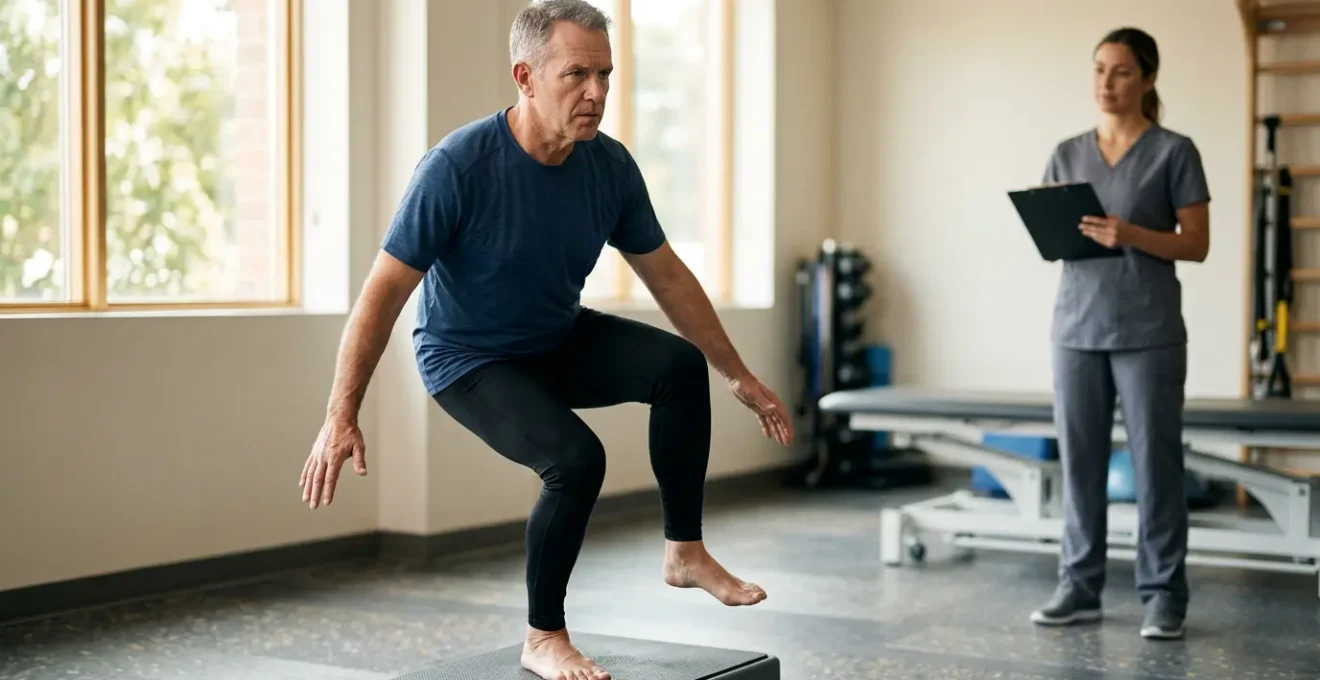
- A sudden feeling of clumsiness often signals a weakening of the brain-body feedback loop, not just muscle weakness or inevitable aging.
- You can actively rebuild these neural pathways with specific, targeted exercises that challenge your coordination and add a cognitive load.
- Introducing movement variability and prioritizing sleep are crucial for maintaining a responsive and adaptable nervous system at any age.
You reach for your morning coffee and knock the cup over. Later, you fumble with your keys, dropping them for the second time this week. A small, nagging voice whispers, “I’m so clumsy lately.” For many adults, these moments are dismissed as simple carelessness or an inevitable part of getting older. We laugh it off, blame fatigue, and move on. But from a neuro-physiotherapist’s perspective, these small stumbles are not random noise; they are valuable data.
What if this perceived clumsiness isn’t a character flaw or a fixed reality, but an active signal from your nervous system? Think of it as a “check engine” light for your brain-body connection. This connection, a constant, high-speed dialogue between your brain and your body’s position in space (a sense called proprioception), can weaken over time if not actively maintained. This isn’t about brute strength; it’s about the precision and speed of your neural wiring.
The good news is that your nervous system is not set in stone. It possesses a remarkable ability to adapt, change, and rewire itself, a process known as neuroplasticity. Instead of passively accepting clumsiness, we can treat it as an invitation to engage in a targeted “software update” for our brain. This article will deconstruct why this neural decline happens and, more importantly, provide a practical toolkit of exercises designed to reboot and strengthen that vital brain-body dialogue, enhancing your agility and confidence in movement.
This guide breaks down the science behind your body’s control system and offers targeted strategies to sharpen it. You will discover why simple, even playful, activities are powerful tools for neurological health.
Summary: Reconnecting Your Brain and Body
- How to Use a Tennis Ball to Sharpen Your Reflexes at Home?
- Why Does Crawling on the Floor Reset Your Nervous System?
- Walking While Talking: Why This Simple Test Predicts Cognitive Health?
- The Repetition Mistake That Makes Your Nervous System Rigid
- How to Use Juggling to Increase Grey Matter Volume in 6 Weeks?
- Trail Running or Treadmill: Which Builds Better Ankle Stability?
- The ‘Drunk’ Effect: Why 17 Hours Awake Equals 0.05% Blood Alcohol?
- Why Pulling an ‘All-Nighter’ Is the Worst Strategy for Exam Success?
How to Use a Tennis Ball to Sharpen Your Reflexes at Home?
A simple tennis ball is one of the most effective and affordable tools in a neuro-physiotherapist’s arsenal. Its power doesn’t lie in building muscle, but in its ability to force your brain’s visual, tactile, and motor-planning systems to work together under pressure. When you drop, catch, or bounce a ball, you’re not just training your hand; you’re training the entire neural feedback loop from your eyes to your brain to your muscles and back again. This isn’t just theory; research on neurological physical therapy demonstrates a potential 40% reduction in clumsiness and fine motor skill difficulties through these kinds of repetitive coordination exercises.
The key is to layer complexity. Simply throwing a ball against a wall is a start, but the real gains come when you add cognitive challenges. This forces your brain to allocate resources, strengthening its ability to multitask and prioritize, which is often where clumsiness originates. By engaging in these drills, you are directly challenging the processing speed and accuracy of your nervous system, effectively “upgrading” its software to better handle real-world demands.
Your Action Plan: Tennis Ball Reflex Training Protocol
- Finger Tapping Warm-up: Before picking up the ball, build foundational fine motor control by touching each finger to your thumb in quick succession, both forward and backward.
- Eye Tracking Practice: Hold the ball and move it around, following it only with your eyes while keeping your head perfectly still. This strengthens visual focus and tracking.
- Multi-Sensory Wall Bouncing: Begin throwing the ball against a wall and catching it. Pay conscious attention to the sound of the bounce (auditory), the feel of the ball in your hand (tactile), and its path through the air (visual).
- Add Cognitive Load: While performing wall bounces, start counting backward from 100 by 7s, or try to name a country for each successful catch. Notice how the physical task becomes harder.
- Incorporate Footwork: Progress to dropping the ball and tapping or trapping it with your foot before it bounces a second time. This integrates the lower body into the neural circuit.
Why Does Crawling on the Floor Reset Your Nervous System?
Crawling is not just for babies; it’s a fundamental human movement pattern that acts as a powerful neural reset. The magic of crawling lies in its cross-lateral (or contralateral) nature. As you move your right arm and left leg forward simultaneously, and then vice versa, you are forcing the right and left hemispheres of your brain to communicate and synchronize in a profound way. This builds and reinforces the corpus callosum, the neural bridge connecting the two halves of your brain. For adults, revisiting this primal movement can help reorganize and refresh a nervous system that has become “stuck” in more limited, linear patterns of movement from years of walking, sitting, and running.
This “whole-body” movement engages your core, shoulders, hips, and limbs in a coordinated effort, re-establishing the proprioceptive dialogue between your entire body and your brain. It’s a low-impact way to improve stability, coordination, and spatial awareness. The act of supporting your own body weight through your hands and feet also provides significant sensory input, waking up receptors that may be under-stimulated in daily life.
The principle of using cross-lateral movement to boost cognitive health is supported by research in related fields. It’s not just about the physical action but the complex coordination it demands from the brain.
The Principle in Action: Cross-Lateral Movement and Brain Health
To understand the power of this movement, look at adjacent research. A study highlighted by the National Academy of Sports Medicine found that dance-based exercise, rich in cross-lateral and rotational movements similar in principle to crawling, was one of the most effective non-pharmacological treatments for individuals with Alzheimer’s. The benefits in memorizing steps, balancing, and coordinating movements demonstrate how this type of activity directly challenges and improves brain function.
Walking While Talking: Why This Simple Test Predicts Cognitive Health?
The ability to walk and talk at the same time seems trivial, but it is a remarkably sensitive indicator of cognitive health and executive function. This is because walking and talking are managed by different parts of the brain. Simple, straight-line walking on an even surface is a highly automated process, controlled largely by subcortical structures. It requires minimal conscious thought for a healthy individual. However, the moment you add a second task, especially a cognitive one like holding a conversation, you engage the prefrontal cortex—the brain’s CEO responsible for planning, decision-making, and multitasking.
If your nervous system is robust, your brain can handle both tasks seamlessly. You can chat, argue, or brainstorm while your body navigates the environment. But if there is underlying neural decline, the brain struggles to allocate resources. It must “borrow” processing power from one task to perform the other. This often manifests as a change in gait: you might slow down, stop walking to make a point, or your walking pattern may become more variable and less stable. This simple dual-task test acts as a real-world stress test for your brain’s executive function.
The table below, based on gait analysis research, illustrates how different walking conditions place varying demands on the brain.
| Walking Condition | Brain Function Engaged | Cognitive Impact |
|---|---|---|
| Straight Walking | Subcortical structures | Minimal cognitive load |
| Walking While Talking | Prefrontal cortex activation | Impacts ability to perform multiple tasks simultaneously |
| Curved Walking | Multiple brain regions | Demands greater cognitive skills |
This data from a study on gait and cognition highlights why dual-tasking while walking is such a potent assessment tool. It’s not just walking; it’s walking while thinking that truly reveals the state of our neural processing.
The Repetition Mistake That Makes Your Nervous System Rigid
In fitness, we often hear “practice makes perfect.” But in neuro-physiotherapy, we say “perfect practice makes permanent… and permanently rigid.” The biggest mistake people make when trying to improve coordination is performing the exact same movement over and over in a perfectly predictable environment. Think of a treadmill: the speed is constant, the surface is flat, and the incline is fixed. While it provides cardiovascular benefits, it teaches your nervous system very little. Your brain quickly automates the pattern and then tunes out. This lack of challenge leads to a less adaptable, more brittle nervous system that is easily “surprised” by a crack in the pavement or an unexpected obstacle in the real world.
The key to a youthful, responsive nervous system is not endless repetition, but movement variability. You need to introduce elements of unpredictability, reaction, and novel challenges. This forces your brain to stay engaged, to problem-solve in real-time, and to build a rich library of movement solutions. Instead of having one single, rigid “program” for walking, you develop thousands of micro-variations that can be deployed instantly. This is the essence of agility.
As experts in the field of neuroplasticity advocate, the goal is to constantly challenge the brain’s existing pathways to stimulate new growth. This means intentionally breaking away from comfortable, predictable routines.
Any way to bring unpredictability and reaction to training will challenge your brain’s pathways and stimulate the growth of new pathways. Be creative in playing with the variables at hand, such as planes of motion, planned vs. unplanned movement, and proprioceptive difficulty.
– National Academy of Sports Medicine, Neuroplasticity and Exercise Research
How to Use Juggling to Increase Grey Matter Volume in 6 Weeks?
Juggling might seem like a circus trick, but it is one of the most powerful neuroplasticity exercises you can undertake. It is the ultimate dual-task challenge, combining rhythmic timing, hand-eye coordination, peripheral vision, and predictive tracking in a continuous loop. More than just a skill, scientific research has demonstrated that the very act of learning to juggle can physically change the structure of your brain in a matter of weeks. It’s a direct, measurable way to combat neural decline.
The process of learning forces your brain to build new connections and strengthen existing ones, particularly in areas associated with visual-motor perception. As you practice, your brain isn’t just learning a motor pattern; it’s enhancing its ability to process complex, fast-moving information and generate precise, timed responses. This is the very definition of improving the brain-body connection. The beauty of juggling is that the benefits are not tied to becoming a perfect performer; they are tied to the process of learning and practicing itself.
This isn’t speculation; it’s been observed in controlled laboratory settings, offering a clear testament to the brain’s remarkable capacity for change when presented with the right kind of stimulus.
The Oxford Juggling Study: A Blueprint for Brain Growth
In a landmark study, researchers at the University of Oxford took a group of 24 adults who could not juggle and scanned their brains. They were then given juggling lessons and asked to practice for 30 minutes a day over six weeks. After six weeks, brain scans revealed significant changes in the white matter—the brain’s “wiring”—in the group that practiced. Crucially, these changes were observed in all participants who practiced, regardless of how skilled they became. This suggests that the effort and engagement in the learning process itself is what drives the structural brain changes, not the final level of proficiency.
Trail Running or Treadmill: Which Builds Better Ankle Stability?
This question gets to the heart of the “repetition mistake” discussed earlier. From a purely neurological standpoint, there is no contest: trail running is vastly superior for building ankle stability and a responsive nervous system. A treadmill offers a perfectly flat, predictable surface that moves beneath you. Your brain and ankles quickly adapt to this monotony, learning a single, rigid motor pattern. The system becomes efficient but fragile, unprepared for the variability of the real world.
Trail running, in contrast, is a masterclass in proprioceptive dialogue. Every footfall is different. Your ankle must constantly micro-adjust to uneven ground, roots, rocks, and changing inclines. This isn’t just a workout for your muscles; it’s a high-intensity workout for your brain. Each step requires your nervous system to:
- Receive a flood of sensory data from the nerves in your feet and ankles.
- Instantly process this data to understand the terrain.
- Calculate the precise, immediate muscular adjustments needed to maintain balance.
- Execute that command and prepare for the next, entirely different step.
This constant, unpredictable challenge builds a robust, intelligent, and highly adaptable connection between your brain and your ankles. It’s the physical embodiment of creating movement variability. While static exercises like single-leg stands have their place, the dynamic, reactive nature of navigating a trail provides a far richer stimulus for neurological adaptation, making your ankles more resilient against twists and your balance more secure in any situation.
The ‘Drunk’ Effect: Why 17 Hours Awake Equals 0.05% Blood Alcohol?
The feeling of being “out of it” after a long day is not just in your head; it’s a measurable neurochemical reality. The comparison to alcohol impairment is startlingly accurate. After approximately 17 hours of continuous wakefulness, your cognitive and motor performance can decline to a level equivalent to having a blood alcohol concentration (BAC) of 0.05%. This is the legal impairment limit in many countries. This “drunk effect” of sleep deprivation directly impacts the systems that prevent clumsiness. Your reaction time slows, your judgment is impaired, and your coordination deteriorates significantly.
Sleep is not a passive state of rest; it’s an active maintenance period for the brain. During sleep, your brain clears out metabolic waste products that accumulate during the day, consolidates memories, and repairs neural circuits. When you skip this crucial process, the build-up of neurotoxins (like adenosine) and the depletion of key neurotransmitters directly degrade the communication between your brain and body. Your cerebellum, the brain region critical for coordinating movement and balance, becomes one of the first and most affected areas. This is why a hallmark of extreme fatigue is stumbling, slurred speech, and poor motor control—symptoms eerily similar to intoxication.
To maintain a sharp brain-body connection, adequate sleep is non-negotiable. For optimal brain function, most adults need seven or more hours of quality sleep per night. During this time, the brain regulates vital neurotransmitters like dopamine and serotonin, which are essential for mood, motivation, and smooth motor control. Regular exercise can improve sleep quality, creating a virtuous cycle where movement during the day preps the brain for better repair at night.
Key takeaways
- Clumsiness is a “check engine light” for your nervous system, not a personality trait or an inevitable part of aging. It’s actionable data.
- Targeted exercises that combine cognitive load and physical movement (like juggling or specific tennis ball drills) are highly effective at rewiring neural pathways.
- Movement variability and adequate sleep are non-negotiable foundations for maintaining sharp and responsive brain-body communication.
Why Pulling an ‘All-Nighter’ Is the Worst Strategy for Exam Success?
Pulling an “all-nighter” before an exam or a big presentation is a classic, yet deeply flawed, strategy. It operates on the false assumption that learning is simply about information input. In reality, learning is a two-step process: acquiring the information and then consolidating it into long-term memory. This consolidation is a physical process where the brain strengthens the neural connections related to the new skill or knowledge. The most critical phase of this process happens during sleep, particularly deep sleep.
When you stay up all night cramming, you are actively sabotaging the second, and arguably most important, step. You may be able to hold information in your short-term memory long enough to regurgitate it, but you are not truly learning. You are preventing the brain from doing the structural work necessary to make that knowledge permanent and accessible in the future. The result is information that is poorly integrated and quickly forgotten. Furthermore, as we saw in the previous section, the sleep deprivation itself impairs your cognitive function, making you less efficient at problem-solving and critical thinking during the exam itself.
True learning—the kind that leads to lasting skill and understanding—requires both practice and rest. The brain needs the stimulus of the new task, followed by the downtime of sleep to rebuild itself stronger.
We suggest that learning of a new task is more critical for the brain to change its structure than simple training of this task once learned… The increase in gray matter is only detectable during constant training of the visual-motor skill and recedes when exercise is stopped.
– Driemeyer et al., PLOS One – Changes in Gray Matter Induced by Learning Study
Stop treating clumsiness as a passive symptom and start seeing it as an active invitation to engage with your own neurology. Begin today by choosing one of these simple exercises—crawl on the floor with a child, practice juggling for five minutes, or toss a tennis ball against a wall while counting backward. Reopening this powerful conversation between your brain and body is the first step toward greater agility, confidence, and long-term neurological health.